What Is a Retaining Wall? (Definitions and Use Cases)
What retaining walls do, where they're needed, the difference between garden walls and engineered retaining walls, and when LA permits apply.
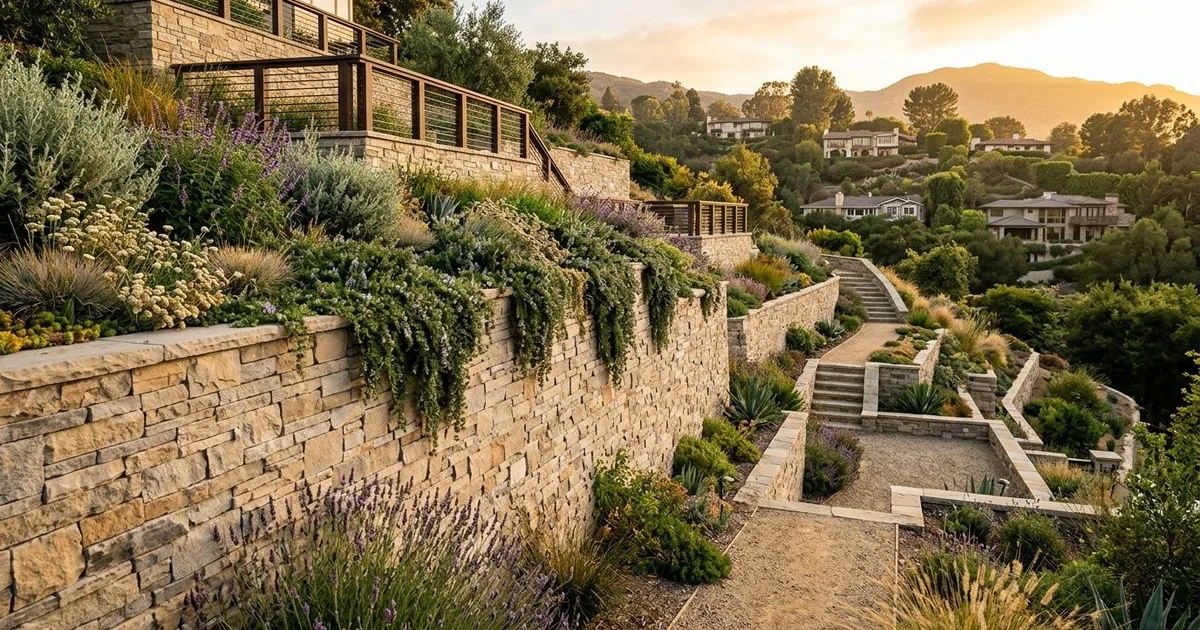
We understand the daily challenge of managing a hillside property in Southern California. If you are wondering what is a retaining wall and how it helps, the answer is straightforward. Capturing scarce rainfall while preventing aggressive soil erosion is a balancing act.
Our team works on the hillside lots that dominate the Pasadena, Glendale, and La Cañada foothills, where these barriers do the heavy structural lifting.
These walls do one specific job by holding back a difference in soil grade that would collapse on its own.
We will break down exactly what these engineered barriers hold back and how to choose the right system for your property. The right materials and drainage make all the difference.
What retaining walls actually hold back
The main retaining wall purpose is to resist three massive downward and outward forces. A proper engineered structure must permanently withstand the following elements:
- Soil weight (lateral earth pressure). This is the mass of soil behind the wall pushing outward at the base. Granular California soils exert an active earth pressure of 30 to 60 pounds per cubic foot depending on the steepness of the slope.
- Water pressure (hydrostatic). Water saturating the backfill pushes on the structure like a dam. Saturated soil can double the lateral force against the wall, making poor drainage the primary cause of structural failure.
- Surcharge. Anything resting on top of the soil behind the wall adds to the load. A standard residential driveway acts as a surcharge load that adds the equivalent of two extra feet of soil weight.
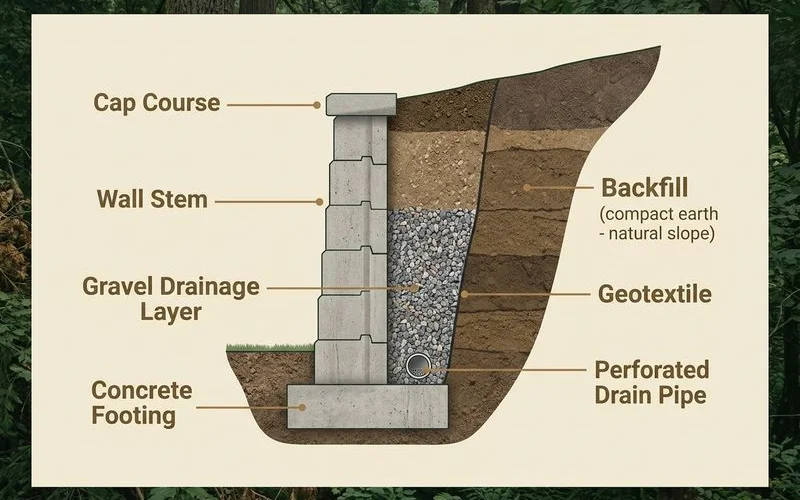
Our engineering process involves sizing the footing, the wall thickness, the reinforcement, and the drainage to handle these three loads with a wide margin of safety. Sizing these elements correctly prevents the structure from tipping or sliding.
Common use cases
Multiple configurations exist for different slope challenges. The most frequent applications we build include:
- Hillside terracing. A steep slope gets broken into walkable benches by two or three short walls. This technique is incredibly effective for drought-conscious landscaping because the flat terraces slow down rainfall runoff and allow water to percolate into the soil.
- Yard expansion on a slope. Cutting into a hillside creates a flat patio area, with the barrier holding back the cut soil.
- Foundation protection. Walls placed along a property edge protect your home when the soil grade rises toward the structure.
- Garden walls and planter borders. Short aesthetic transitions under two feet define planting beds and seat walls.
- Driveway grade transitions. A barrier holds back the upper soil grade where a driveway cuts into a steep slope.
Garden wall vs engineered retaining wall
When comparing a retaining wall vs garden wall, the key distinction in residential work comes down to the retained height and the structural requirements.
| Feature | Garden wall | Engineered retaining wall |
|---|---|---|
| Retained height | Same grade or under 24 inches | Over 24 inches, commonly 4 feet or more |
| Drainage | Often unnecessary | Required (French drain and weep holes) |
| Footing | Modest | Engineered to load with a minimum 1,500 psf bearing capacity |
| Permit (LA) | Usually no | Yes for 4 feet or more of retained height |
| Engineered drawings | No | Yes |
| Geotech report | No | Often yes |
A 30-inch garden boundary around a planter is one type of project. A 7-foot engineered barrier holding up a hillside is a fundamentally different class of construction. They might look similar from across the yard, but they require entirely different design standards, permits, and budgets.
Our team approaches each type with the appropriate level of structural planning. You cannot simply stack stones higher and expect them to hold a slope.
When LA permits apply
In most Los Angeles area cities, a structure under 4 feet of retained height does not trigger a permit requirement. Notice that the rule focuses on retained height, not the total height of the materials. Walls at or above 4 feet do require a permit, which initiates several mandatory steps.
The LADBS permit process for 2026 requires a formal site plan showing specific setbacks according to the Los Angeles Municipal Code. The permit triggers:
- Engineered structural drawings
- Geotechnical soils report
- Drainage and backfill detail
- Plan check at the city desk
- City inspection during the construction phases
Pasadena B&S, LADBS, BHEC (Beverly Hills), and the other LA-area city desks each handle this slightly differently. Specific thresholds and submittal requirements vary based on the municipality.
Our contractors confirm the exact requirements during the initial site visit. For retaining wall permit specifics, see the dedicated guide.
Types of retaining walls
Multiple systems work well for different soil conditions and aesthetic preferences. The most reliable options include:
- Segmental retaining walls. These stacked block systems use no mortar and work perfectly for lower barriers. Leading brands like Allan Block must meet ASTM C1372 standards, which guarantee a minimum concrete compressive strength of 3,000 psi.
- CMU (concrete masonry unit). Mortar-set blocks use steel reinforcement to create strong engineered barriers.
- Poured concrete. This method offers the highest engineering load capacity and the thinnest profile per foot of height.
- Stone-faced. An engineered structural core sits behind a decorative natural stone veneer.
We recommend reviewing the specific costs and benefits of each material before making a choice. For more information on choosing between systems, check out the guides on types of retaining walls and engineered concrete vs segmental.
What separates a wall that lasts from one that fails
A retaining wall is only as strong as its weakest component. Three critical elements separate a permanent asset from a structural liability.
Sizing the Footing
Footings sized correctly to the load prevent the entire structure from tipping or settling into the earth. The California Building Code typically requires a minimum allowable soil bearing value of 1,500 pounds per square foot for the foundation. Undersized footings fail quickly under the immense weight of wet soil.
Proper Drainage
Hydrostatic pressure is the single most common cause of retaining wall failure. A two-foot wall with saturated soil behind it experiences roughly double the lateral pressure compared to a properly drained wall. Hydrostatic pressure builds up without a French drain and crushed gravel backfill, causing the barrier to bulge and eventually blow out.
Adapting to Soil Types
The right system must match the specific soil conditions on your property. Heavy clay soils expand and retain moisture, requiring very different engineering than well-drained sandy soils.
Get those three factors right, and your wall becomes a 50-year asset. Skip any of them, and it turns into a 10-year liability.
That is the engineering and build discipline behind Ridgeline’s retaining walls and hillside service. Our projects are designed for the actual conditions on your lot, permitted in-house, and fully warrantied. Every structure built by Ridgeline undergoes rigorous quality checks. If you need to secure a slope or manage water runoff on your property, contact us today to schedule a site evaluation.
Frequently Asked Questions
What's the difference between a retaining wall and a garden wall?
Do all retaining walls need a permit?
How long does a retaining wall last?
Have questions about a project of your own?
A free on-site consultation, a phased budget tier, and a master plan that fits your property and your goals.