Types of Retaining Walls: Which Is Right for Your LA Lot?
Segmental, CMU, poured concrete, and stone-faced retaining walls compared. When each is the right call and how cost and engineering differ.
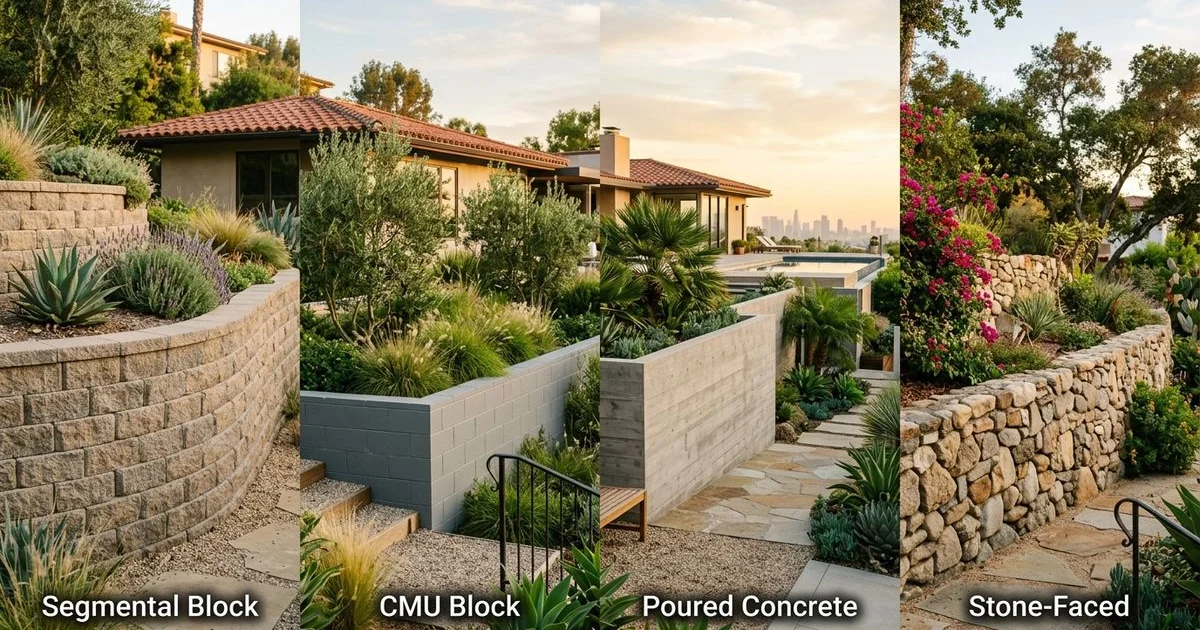
You know how quickly a steep, dry hillside can become an erosion nightmare during a heavy California downpour. We see this issue constantly across Los Angeles residential properties. Managing that slope safely requires evaluating the different types of retaining walls to match your specific soil conditions, retained height, and budget. Proper terracing also helps capture rainfall and slows runoff, which is a big win for drought-conscious homeowners. Our team will break down the four main systems used in local hillside work, compare their 2026 costs, and show you exactly how to make the best structural choice.
Segmental retaining walls (Allan Block, Versa-Lok, Keystone)
Stacked precast concrete blocks with engineered interlocking. No mortar. Reinforced with geogrid mesh into the backfill on taller installations.
We often recommend this modular approach for residential terracing. Segmental blocks offer inherent flexibility and excellent drainage. Water can seep naturally through the mortarless joints, relieving hydrostatic pressure before it damages the structure. This permeable design makes segmental walls highly compatible with drought-tolerant landscaping.
Terracing a slope with these blocks creates flat planting beds that capture rainfall instead of letting it run off into the street. Planting low-water varieties like Echeveria or Sedum in these newly leveled zones stabilizes the soil further. Our landscape crews find that using brands like Allan Block or Versa-Lok speeds up installation significantly.
Materials alone for these blocks cost between $4 and $10 each in 2026. A fully installed system generally runs $20 to $45 per square foot for walls under six feet. Taller walls require geogrid soil reinforcement, which adds to the final expense.
- Best for: Walls 1 to 8 feet retained height. Hillside terracing. Garden walls. Mid-budget projects.
- Pros: Fast install, no mortar work, wide aesthetic range (textured faces, color options), modular and forgiving of minor settling.
- Cons: Height limits beyond 8 feet without specialty engineering. Some aesthetic limits, as segmental walls always look like stacked blocks rather than continuous masonry.
- Cost: $40 to $100 per square foot of total wall face (including labor and base prep).
CMU (concrete masonry unit) walls
Mortared concrete block stems on poured-concrete footings, often with steel reinforcement. Frequently faced with stucco, stone veneer, or tile.
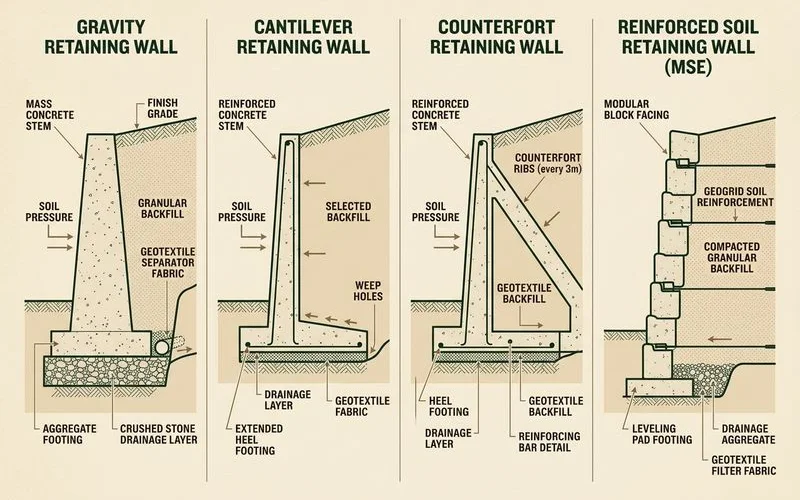
This method provides massive structural strength for holding back heavy soils. A 10-foot wall retaining saturated earth experiences roughly four times the lateral pressure of a 5-foot wall. We rely heavily on proper waterproofing to keep these rigid structures from failing.
Moisture trapped behind a solid CMU wall will eventually cause the mortar to degrade or the face finish to pop off. Using a reliable sheet membrane, like Carlisle CCW MiraDRI 860/861, provides a waterproof barrier that lasts 30 to 50 years. Dimpled drainage boards placed directly over that membrane then channel water safely down to a perforated footing drain.
Our engineers specify this exact layered protection on nearly every permitted CMU project in the city. The Los Angeles luxury residential market demands a flawless finish. A water stain bleeding through fresh LaHabra stucco ruins the aesthetic completely.
- Best for: 4 to 10 feet retained height. Engineered walls under permit. Residential walls in traditional styles.
- Pros: Excellent engineering capability. Can be finished with virtually any face material. Familiar to most local building departments.
- Cons: Slower to build than segmental. Requires skilled masons. Mortar and reinforcement add significant cost.
- Cost: $80 to $150 per square foot of wall face including the final face finish.
Poured concrete walls
Cast-in-place reinforced concrete, formed and poured on site. Often the highest engineering load capacity per linear foot.
These solid concrete structures handle the most extreme hillside loads imaginable. Severe slopes or properties carrying a surcharge load require specialized foundation work before the wall is even poured. We frequently coordinate the installation of drilled caisson piers on these complex sites.
A caisson is a concrete shaft drilled deep into the ground to bypass unstable surface soils. Reaching stable bedrock can require drilling 20 to 80 feet down. Each pier costs between $15,000 and $50,000 depending on the required depth and soil conditions.
Our structural teams build the poured concrete wall directly on top of these deep foundations. The resulting monolithic wall is incredibly strong but highly labor-intensive to form and cure properly.
For a detailed head-to-head comparison on segmental vs concrete retaining, see engineered concrete vs segmental retaining.
- Best for: Tall walls over 8 feet retained height. Surcharge loads like a driveway or house located above the wall. Highest-engineering hillside work.
- Pros: Strongest and thinnest wall stem per height. Best option for exceptionally tall walls. Continuous monolithic construction prevents localized block failure.
- Cons: Most expensive per foot. Forming is highly labor-intensive. Hard to modify or cut into after the initial pour.
- Cost: $120 to $250+ per square foot of wall face depending on height, reinforcement, and access.
Stone-faced walls
A structural wall, typically engineered CMU or poured concrete, with a decorative stone face mortared on. The structural work is identical to a CMU wall, but the face changes the aesthetic dramatically.
Natural stone veneers blend flawlessly into Southern California landscapes. Using locally sourced materials like Santa Barbara sandstone or Bouquet Canyon stone gives the property an authentic, established look. We find that this finish style matches the architectural heritage of many classic Los Angeles neighborhoods perfectly.
The structural core handles the soil weight, while a skilled mason applies the heavy natural stone one piece at a time. This dual-layer construction makes it the most expensive option on the market. Our masonry crews take great care to shape and fit each stone to create the illusion of a dry-stacked wall.
- Best for: Heritage homes featuring Craftsman, Spanish-revival, or Mediterranean architecture. Estate-scale work. Specific high-end zones like San Marino, Beverly Hills, and the older Pasadena neighborhoods.
- Pros: Looks identical to traditional dry-stack stone walls but carries full modern engineering. Wide aesthetic range including granite, sandstone, and basalt.
- Cons: Most expensive of the four main systems. Requires paying for both a structural wall and the subsequent mason-set face stone.
- Cost: $150 to $350+ per square foot of finished wall face.
Comparison table
| System | Best heights | Cost/sq ft face | Aesthetic | Permeability & Drainage |
|---|---|---|---|---|
| Segmental | 1 to 8 ft | $40 to $100 | Textured block, varied colors | High (water seeps through joints) |
| CMU | 4 to 10 ft | $80 to $150 | Stucco, stone face options | Low (requires strict membrane/board) |
| Poured concrete | 8 ft+ | $120 to $250+ | Smooth, can be faced or board-formed | Zero (relies entirely on pipe drains) |
| Stone-faced | All heights | $150 to $350+ | Heritage, estate, natural stone | Low (sealed mortar joints block water) |
Engineering considerations
For permit-required walls, the engineering process is essentially the same regardless of system. The wall type changes how the structural drawings look but doesn’t change the foundational steps.
The Los Angeles Department of Building and Safety (LADBS) requires a permit for any retaining wall exceeding four feet in height. This measurement starts from the bottom of the wall’s footing, not the visible grade line. We strongly advise confirming your exact permit needs before buying a single piece of material.
If your wall supports a driveway or sits on a steep slope, you need an engineered design regardless of the height. Hillside construction also faces strict grading limits. The Baseline Hillside Ordinance caps grading at a base of 500 cubic yards plus five percent of your total lot size.
Our project managers handle this entire bureaucratic process for you. A typical permitted project flows through these specific stages:
- Geotechnical report evaluating the specific soil conditions on site.
- Engineered structural drawings mathematically sized to support the soil and surcharge load.
- Comprehensive drainage details, including a subdrain system with a 4-inch perforated PVC pipe in a gravel-filled trench.
- Permit submittal and review at the city desk.
- Mandatory city inspections at various stages during construction.
Mixed-system projects
A typical Ridgeline hillside project combines two or more systems. Mixing retaining wall systems is completely normal, as different parts of the same property require different load capacities and aesthetics.
Using poured concrete for a massive lower retaining wall provides critical safety for the slope. Transitioning to segmental blocks for the upper terraces saves money and creates plant-friendly garden zones. We often design these hybrid layouts to maximize both budget efficiency and visual appeal.
A smart drought-tolerant layout uses the porous nature of segmental walls to handle water runoff near the top of the slope. The impermeable structural walls at the base then catch and redirect any remaining water safely into city storm drains. Our designers use this strategy to create functional, tiered outdoor living spaces.
A standard mixed-use property plan generally includes:
- Tall structural walls holding back 5 or more feet of soil in CMU or poured concrete.
- Shorter terracing walls built with segmental blocks to slow rainwater runoff.
- Garden walls and casual seat walls constructed in segmental blocks or CMU.
- Stone-face finishes applied only to the most visible structural walls near the home.
Where to start
Wall-type selection is a design decision made at the site visit, after soil conditions and retained heights are understood.
Every yard behaves differently during an intense rainstorm. Sometimes the homeowner has an aesthetic preference, like a natural stone face to match a historic home. Sometimes the raw engineering requirements dictate the final material choice.
We walk through all these variables during our initial property assessment. Balancing your visual preferences with the strict structural realities of California hillside living remains our top priority. Discussing these specific details is the first step in our retaining walls service.
Frequently Asked Questions
Which retaining wall type is most cost-effective?
Can I mix wall types on one project?
Which type lasts longest?
Have questions about a project of your own?
A free on-site consultation, a phased budget tier, and a master plan that fits your property and your goals.