Retaining Wall Cost in California (2026 Guide)
Real California retaining wall costs by type, height, and engineering scope — segmental, CMU, poured concrete, and stone-faced — including permits and geotech.
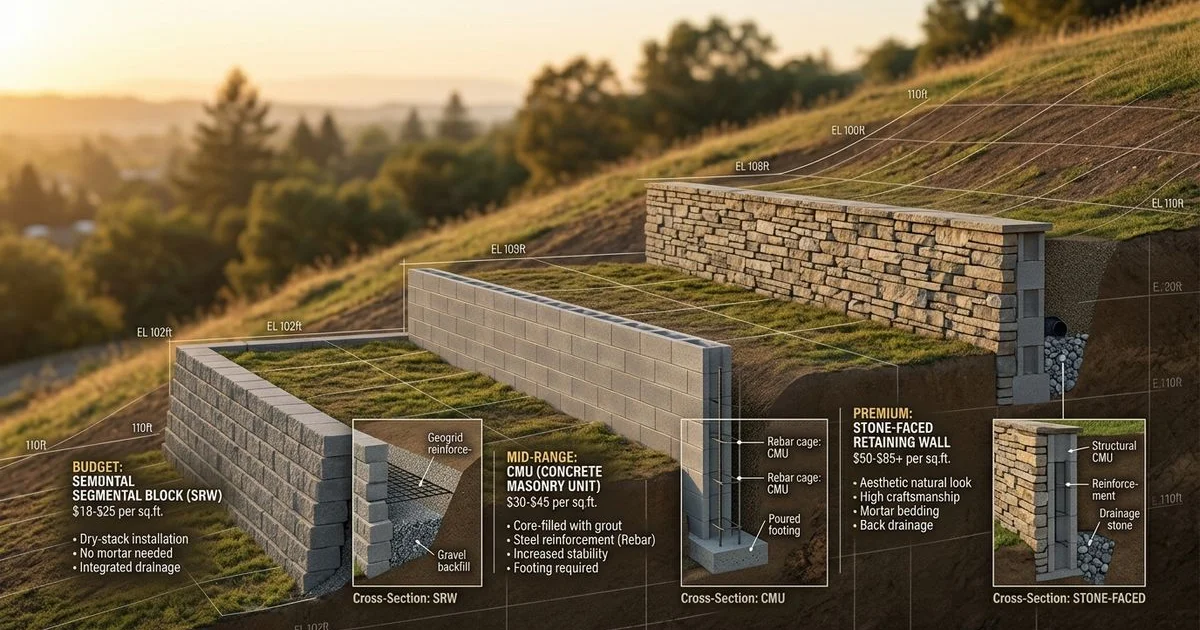
We founded Ridgeline Outdoor Living to provide exceptional landscaping and hardscaping services.
Finding accurate retaining wall cost california data can feel like a guessing game for most property owners.
Our crews see clients constantly surprised by the hidden fees tied to engineering and local permits.
The reality is that a four-foot height threshold dictates almost everything about your budget.
Let’s look at the hard data for 2026, break down the actual expenses, and explore a few practical ways to keep your project on track.
Cost ranges by wall type and height
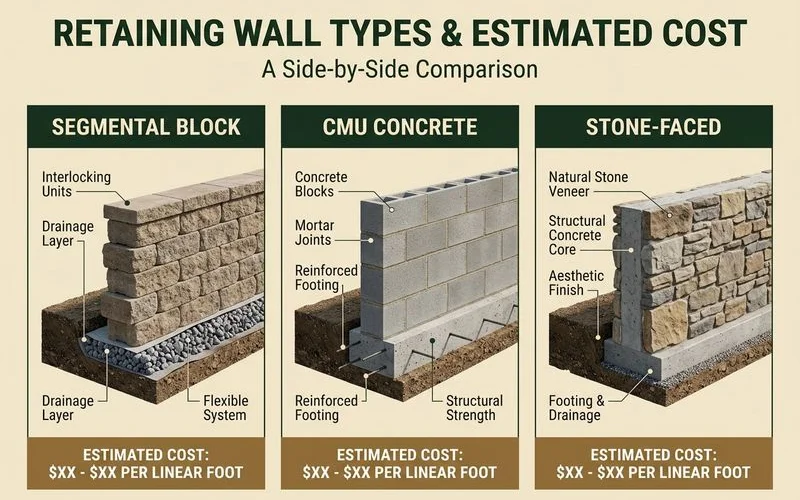
Segmental block walls cost between $60 and $120 per linear foot for heights under four feet. Poured concrete walls exceed $800 per linear foot once they surpass eight feet in retained height.
We update these figures annually, and the 2026 data shows specialized hardscape labor rates in California now sit between $60 and $90 per hour.
| Wall type | Under 4 ft retained | 4-6 ft retained | 6-8 ft retained | Over 8 ft |
|---|---|---|---|---|
| Segmental block | $60 to $120/lf | $120 to $200/lf | $200 to $300/lf | Approaches concrete |
| CMU (stuccoed) | $150 to $250/lf | $250 to $400/lf | $400 to $600/lf | $600+/lf |
| Poured concrete | $200 to $350/lf | $350 to $500/lf | $500 to $800/lf | $800+/lf |
| Stone-faced (engineered) | $250 to $450/lf | $450 to $650/lf | $650 to $1,000/lf | $1,000+/lf |
These are linear-foot prices for average heights within each bracket.
Our crews have found that numbers falling below these ranges usually indicate cut corners on drainage, foundation depth, or engineering requirements.
Poured concrete installations have seen the sharpest price hikes this year because of rising formwork and lumber costs.
Where the money goes
The actual wall materials only make up about 25 to 40 percent of the total budget. The remaining funds cover excavation, foundation footings, and vital drainage systems.
We constantly warn homeowners that what happens underground determines the lifespan of the structure. High-quality geotextile fabrics like Mirafi and heavy-duty ADS perforated pipes add upfront expenses but prevent catastrophic blowouts later.
- Excavation and earthwork: 15 to 25 percent (often higher due to $500 to $1,500 soil export fees at California landfills)
- Footing (concrete, rebar): 10 to 20 percent
- Wall stem (block, masonry, concrete): 25 to 40 percent
- Reinforcement (rebar, geogrid like Tensar): 5 to 15 percent
- Drainage system (pipe, gravel, geotextile): 8 to 15 percent
- Backfill in compacted lifts: 5 to 10 percent
- Finish (face, cap, edge details): 5 to 15 percent
- Permits and engineering (for permitted walls): 5 to 10 percent
Our team factors in a minimum of $5,000 to $15,000 in soft costs for geotechnical and structural engineering whenever a wall exceeds four feet. Soil export alone has become a massive budget line item in recent years.
Permitting and geotech costs
Walls at or above four feet in retained height require specialized permits and engineering approval across most Los Angeles area cities. This height threshold triggers mandatory soils reports and structural plan checks.
We see clients hit with surprise delays when they ignore the Los Angeles Department of Building and Safety (LADBS) regulations. According to LAMC Section 91.106.3.2, walls under four feet are generally exempt from building permits, provided they do not support a surcharge load.
Our experience shows that geotechnical engineers currently charge $100 to $250 per hour for site testing.
- Geotechnical report: $1,500 to $5,000 (Average LA residential soil reports run about $2,700 in 2026)
- Structural engineering: $2,000 to $8,000 depending on seismic complexity
- City permit fee: $500 to $2,500
- Plan check resubmissions: $500 to $2,000 if corrections are needed
These soft costs never appear on standard linear-foot estimates, yet they heavily influence the retaining wall price ca residents actually pay. You must factor these administrative steps into your initial budget to avoid stalling mid-project.
Examples by project
Real-world projects show exactly how material choices and site access change the final bill. A simple terraced garden will cost around $13,500, while a massive structural estate wall can easily surpass $58,000.
We compiled these four distinct scenarios to help you benchmark your own upcoming property improvements. Local topography and soil conditions dictate the structural needs of every single build.
Short segmental terracing (typical residential hillside)
This approach utilizes three small walls, each 30 linear feet by 3.5 feet retained, totaling 90 linear feet.
We love this strategy because staying under the four-foot mark completely bypasses expensive engineering fees. Drought-tolerant plants like Agave and California Lilac pair perfectly with these low terraces to minimize water runoff.
- 3 walls, each 30 lf x 3.5 ft retained = 90 lf total
- Segmental blocks at $90/lf = ~$8,000
- Drainage and minor grading = $2,500
- Planting integration for water conservation = $3,000
- Total: ~$13,500
Single engineered CMU wall (mid-scale hillside)
A single 40-foot wall retaining six feet of earth creates 240 square feet of face area.
Our crews must pour deeper concrete footings for this height to satisfy strict local seismic codes. The added engineering paperwork instantly adds $9,000 to the baseline material costs.
- 1 wall, 40 lf x 6 ft retained = 240 sq ft face
- CMU stuccoed at $300/lf = ~$12,000
- Heavy-duty drainage setup = $1,500
- Permit, geotech report, and structural engineering = $9,000
- Total: ~$22,500
Stone-faced estate wall (Beverly Hills / San Marino)
This luxury 60-foot wall holds back seven feet of soil, requiring 420 square feet of premium finishing.
We frequently use natural ledgestone veneers on these projects to match existing high-end architecture. The premium finish alone pushes the base structural cost up by 50 to 100 percent.
- 1 wall, 60 lf x 7 ft retained = 420 sq ft face
- Engineered stone-faced base at $700/lf = $42,000
- Advanced drainage network = $4,000
- Permit, geotech report, and structural engineering = $12,000
- Total: ~$58,000
Hillside multi-wall project (typical La Cañada terraced lot)
This complex design uses four distinct walls in a mix of segmental and CMU stone-faced styles.
Our team often encounters expansive clay soils in areas like La Cañada, which require substantial footing upgrades. The combined 200 linear feet of structure perfectly balances aesthetics with intense slope stabilization.
- 4 walls in mixed segmental and CMU stone-faced
- Segmental terraces (120 lf at $130/lf) = $15,600
- CMU stone-faced taller wall (40 lf at $500/lf) = $20,000
- Comprehensive drainage system = $6,000
- Permit, geotech report, and structural engineering = $14,000
- Slope grading and drought-resistant planting = $15,000
- Total: ~$70,600
What pushes cost up the fastest
Retained height and limited site access are the two biggest factors that inflate project budgets. A six-foot structure requires exponentially more steel, concrete, and engineering than a four-foot version.
We constantly remind property owners that engineering scales non-linearly. Surcharge loads from driveways, swimming pools, or heavy hardscaping demand massive structural reinforcement.
Our equipment operators cannot use standard skid steers on tight hillside lots without driveway access. Hand-digging trenches easily adds 20 to 40 percent to your total labor bill.
- Retained height: Engineering requirements multiply rapidly, making taller structures 2 to 3 times more expensive than shorter ones.
- Stone or premium face finish: Adding natural stone veneers easily increases structural costs by 50 to 100 percent over the base.
- Surcharge loads: Weight from a nearby structure or parked vehicles demands heavier reinforcement.
- Expansive clay soils: Common throughout the state, these soils expand when wet and require much deeper, costlier concrete footings.
- Difficult site access: Hillside properties lacking driveway access force crews to transport materials by hand.
- Curved walls: Radius work requires specialized block cutting and significantly more labor time.
- Short site easements: Tight access from neighbors or adjacent property reduces equipment options.
What keeps cost down
You can save money easily by building multiple short terraces instead of one massive structure. Staying under four feet eliminates the need for expensive permits and soil reports.
We highly recommend utilizing basic segmental systems like Keystone or Allan Block for the most efficient installation. Standard stucco finishes provide a clean look at a fraction of the cost of natural stone.
The total retaining wall installation cost drops significantly when you apply these straightforward methods.
- Segmental walls under 4 ft: These avoid the LADBS permit trigger and install rapidly.
- Standard wall faces: Plain stucco remains highly cost-effective compared to masonry veneers.
- Linear, simple geometry: Straight designs eliminate the labor-intensive cutting required for corners and curves.
- Multiple short terraces: Breaking a steep slope into multiple short drops saves thousands in engineering fees when the slope allows.
- Installation alongside other hardscape: Installing your retaining wall alongside new drought-friendly landscaping consolidates excavation, drainage, and trenching tasks.
What you should never cut
You must never compromise on foundation depth, backfill compaction, or drainage mechanisms. Cutting corners on these structural elements guarantees a premature and dangerous failure.
We have replaced countless collapsed systems because the original builder skipped the crushed rock backfill. You must install a proper French drain at the toe of the footing to manage water pressure effectively.
- Footing depth and reinforcement
- French drain at the toe
- Class 2 permeable rock (for proper water filtration behind the face)
- Weep holes through the face
- Compacted backfill in lifts
- Engineered drawings on permitted walls
- Geotech report when required
Our experts have documented the exact reasons these structures collapse, and you can see the details in our guide on why retaining walls fail.
Proper installation discipline is paramount, and you can review our specific methods on the Ridgeline retaining walls service page to start planning your secure, long-lasting project.
Frequently Asked Questions
What's a typical California retaining wall cost per linear foot?
What pushes retaining wall cost up the fastest?
Are there cheaper retaining wall options?
Have questions about a project of your own?
A free on-site consultation, a phased budget tier, and a master plan that fits your property and your goals.