Engineered Concrete vs Segmental Retaining Walls (LA Comparison)
Side-by-side comparison of engineered CMU/poured concrete and segmental retaining walls — cost, height, aesthetic, and when each wins.
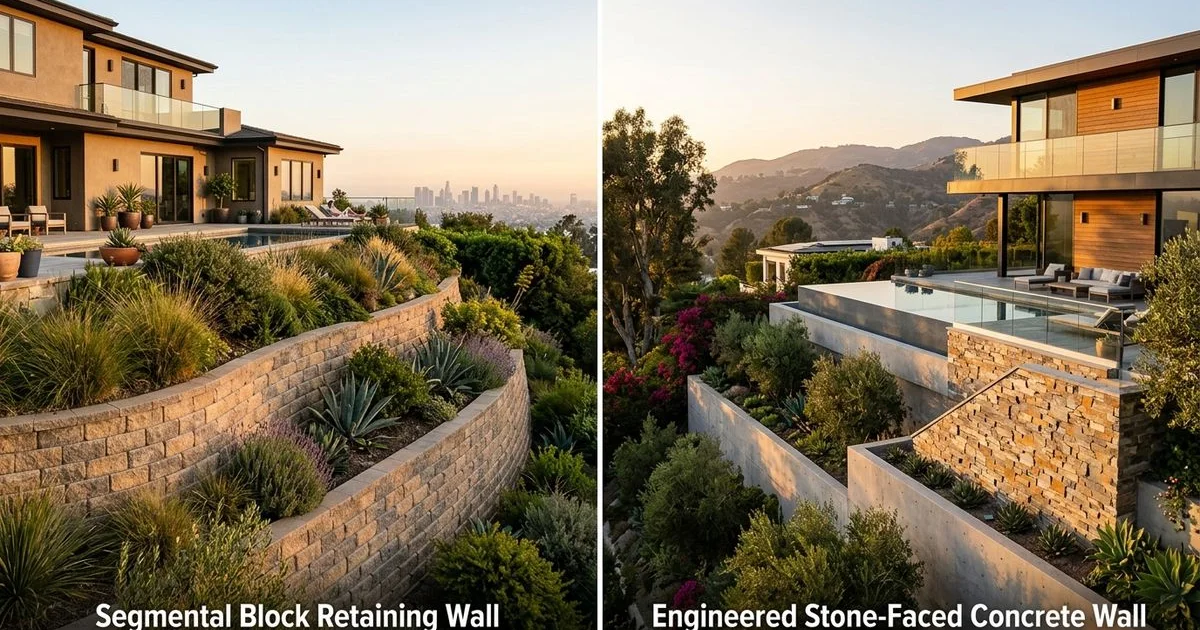
Our founders built Ridgeline Outdoor Living with a simple mission: to provide exceptional landscaping and hardscaping services that customers can truly rely on. This commitment means giving you honest answers to the most common retaining wall questions we hear in La Cañada, Glendale, and the Pasadena foothills.
We constantly help homeowners make the engineered concrete vs segmental retaining wall choice. The decision involves much more than just matching your drought-tolerant landscaping.
Our team knows that California’s seismic activity and sudden downpours require a structure that handles severe stress.
A quick look at the actual data will show you exactly how to pick the most durable option.
What each system actually is
We define a segmental retaining wall, or SRW, as a flexible system of stacked precast concrete blocks with engineered interlocking features. These manufactured blocks, such as Versa-Lok or Keystone, use their own weight and a built-in setback angle to hold back soil without mortar.
Our installations reinforce taller walls by tying a geogrid mesh directly into the backfill, while drainage runs through a graded gravel chimney right behind the structure. Both systems easily handle the permit-required loads in Southern California, but their construction approaches differ significantly.
- Segmental Structure: Built without mortar, relying on mass, setback angles, and interlocking pins for stability.
- Engineered Concrete: Built using either mortar and steel-reinforced concrete masonry units (CMU) or poured concrete in custom on-site forms.
Our experience shows that flexible segmental walls handle expansive clay soils and minor seismic shifts incredibly well. Concrete walls offer unmatched strength for massive loads, but they risk cracking if the underlying soil moves unexpectedly.
Cost relativity
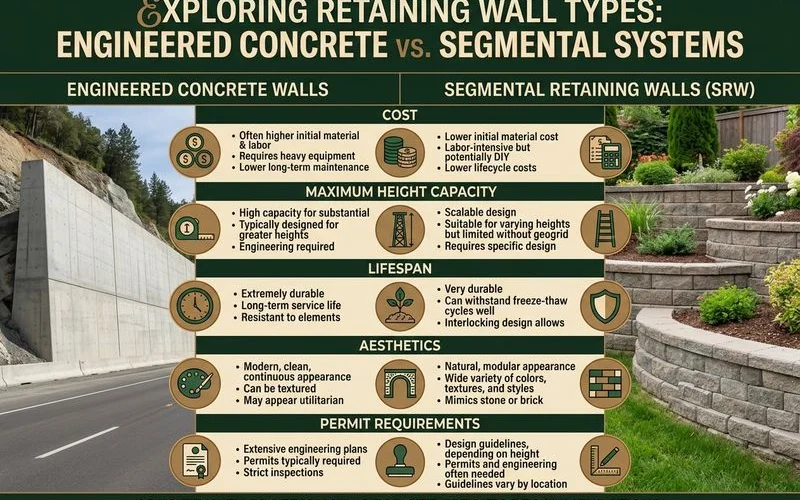
Our updated 2026 pricing for the Los Angeles area shows that segmental block is meaningfully cheaper for most short-to-medium residential walls. Material costs for standard SRW blocks hover around $10 to $18 per square foot, while labor and base preparation make up the rest of the total.
| Retained height | Segmental | Engineered concrete |
|---|---|---|
| Under 4 ft | $40 to $70/sq ft face | $80 to $120/sq ft face |
| 4 to 6 ft | $60 to $100/sq ft face | $100 to $160/sq ft face |
| 6 to 8 ft | $80 to $130/sq ft face | $120 to $200/sq ft face |
| 8 ft+ | Approaches concrete pricing | $150 to $300+/sq ft face |
We find that the cost gap closes quickly as walls grow taller. Tall segmental projects demand extensive geogrid layers and engineering designs that closely rival the complexity of poured concrete.
Our clients often ask about the cmu vs segmental wall price difference. Poured and CMU options require expensive steel rebar schedules, structural engineering stamps, and highly skilled masonry labor.
Height capability
We evaluate wall height limits based on safety standards and local Los Angeles permit requirements. Both systems safely manage residential loads, but the engineered wall vs block wall comparison changes as elevation increases.
- Segmental block: The practical residential range spans 1 to 8 feet retained. Going over 8 feet is technically possible with massive geogrid integration, but the math usually pushes the decision toward concrete.
- Concrete masonry units (CMU): The standard working range covers 4 to 10 feet. Skilled masons easily push this higher when backed by proper steel reinforcement.
- Poured concrete: This option features almost no practical height limit in residential backyards. The tallest structural walls on steep California hillsides almost always use poured concrete.
Our structural engineers step in whenever a wall exceeds the standard height thresholds. Any wall taller than 4 feet in the LA area requires a building permit, while walls over 8 feet trigger a mandatory geotechnical soil analysis.
Aesthetic comparison
Our design process focuses heavily on how the final structure integrates with your existing landscape. Each material provides a distinctly different visual footprint for your yard.
- Segmental: Always reads as a modular wall with visible block faces and a regular pattern. Wide ranges of textures, like split-face or smooth, complement drought-tolerant succulents and native grasses beautifully. Clean colors create a sharp modern look, while weathered tones fit perfectly with traditional gardens.
- CMU: The structural shell can easily remain invisible behind a decorative face. Homeowners often cover the mortar lines with stucco, stone veneer, plaster, or tile.
- Poured concrete: This method delivers a smooth, monolithic surface. The face can be left exposed with a board-form or sandblast finish for the most modern aesthetic of the three options.
- Stone-faced (CMU or poured behind): This technique mimics a hand-stacked stone wall while providing full engineering. This premium finish remains the absolute best choice for heritage homes and estate projects.
We always recommend matching the wall material to your primary outdoor living spaces. For more details on material choices, check out this guide on types of retaining walls.
When each wins: engineered concrete vs segmental retaining wall
We evaluate soil conditions, slope severity, and your project budget to determine the winning system. The right choice depends entirely on specific site geometry rather than personal preference alone.
Segmental wins when…
Our landscaping crews prefer segmental blocks for projects that require multiple short terraces. This system is highly permeable, making it excellent for managing sudden rainfall in drought-conscious garden beds.
- The wall retains less than 6 feet of earth.
- The project sits on a strict budget, but reliable engineering still matters.
- The garden aesthetic suits a modular, textured look.
- The property features expansive clay soils that require a flexible structure.
- The site access heavily limits the use of large heavy equipment.
Engineered concrete wins when…
We switch to engineered concrete when gravity blocks simply cannot handle the required loads. A solid footing provides necessary stability for steep drop-offs and heavy surcharge weights.
- The wall holds back more than 8 feet of retained soil.
- The structure supports a significant surcharge load, like a driveway or building above it.
- The design requires a specific face finish, such as stone veneer, board-form, or integral coloring.
- The home’s modern architecture demands a continuous monolithic appearance.
- The site lacks the required excavation space behind the wall for segmental geogrid layers.
Permit and engineering
Our team handles the Los Angeles permitting process so you never have to worry about compliance. Both systems require official permits at or above the standard 4-foot retained height threshold in most local cities.
We approach the structural drawings differently based on the material you select. Segmental walls reference standard manufacturer engineering charts, while CMU and poured walls require custom structural drawings.
Our geotech partners remind us that any wall built on a slope greater than 25 percent needs explicit engineer approval. This rule translates to a 1-foot rise for every 4 feet of horizontal distance.
We highly recommend reading more about the local requirements before starting a hillside project. For more on the paperwork process, see this guide on retaining wall permits in LA.
Mixed-system projects
We frequently design mixed-system layouts for steep Southern California properties. A very common pattern on hillside projects uses tall structural walls in stone-faced CMU for heavy surcharge loads and visible faces.
Our crews then build shorter terracing walls out of segmental block to create beautiful, drought-friendly planting beds. The exact same project utilizes both systems, letting each material play directly to its core strengths.
We rely on careful engineering and design decision-making rather than defaulting to a single approach. That strategy drives the success behind Ridgeline’s retaining walls service, ensuring you get the right wall type for every specific location.
Our experts are ready to evaluate your engineered concrete vs segmental retaining wall options and secure your property for the future. Schedule a site visit today to discuss the perfect structural solution for your home.
Frequently Asked Questions
Which is cheaper, segmental or engineered concrete?
Which lasts longer?
Which is better for hillside homes?
Have questions about a project of your own?
A free on-site consultation, a phased budget tier, and a master plan that fits your property and your goals.