How Much Does Drought-Tolerant Landscaping Cost in California?
Real California costs for drought-tolerant landscaping by yard size and material tier. Design-fee vs install split, rebate offsets, and what drives cost up or down.
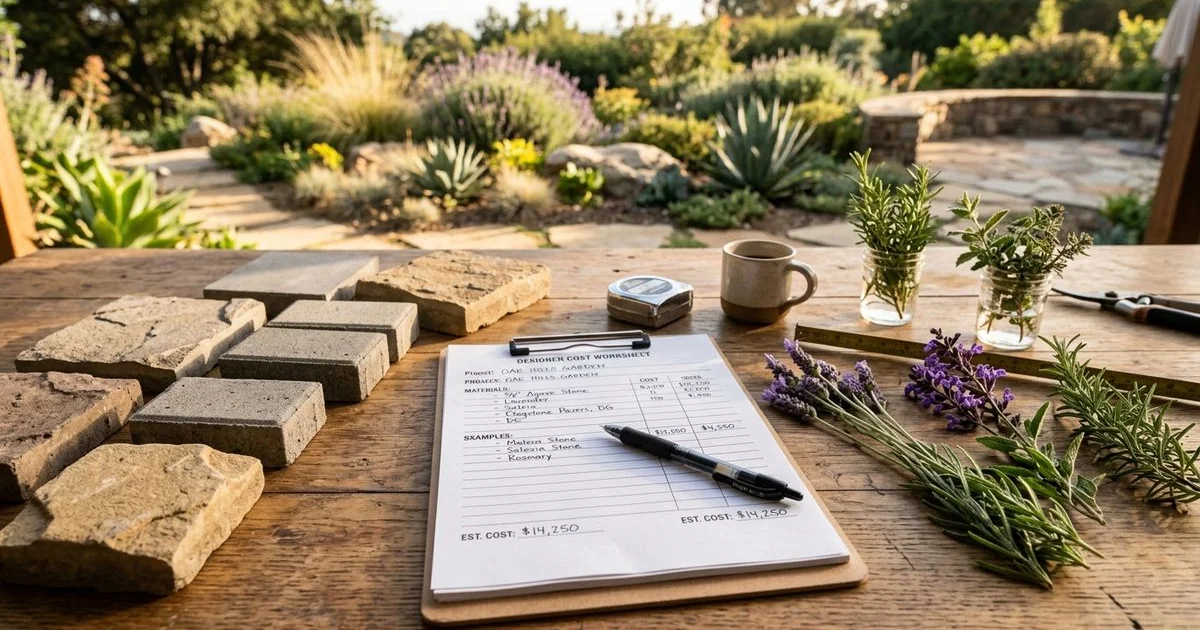
We at Ridgeline Outdoor Living often hear the exact same question from homeowners reviewing their high utility bills.
The honest answer regarding any drought tolerant landscaping cost california search is that it depends on yard size, slope, material tier, and how much structural work the project includes. You can still plan your budget around several highly reliable pricing tiers.
We rely on this exact breakdown during dependable budget conversations with Pasadena, Glendale, and Westside clients.
Cost bands by yard size
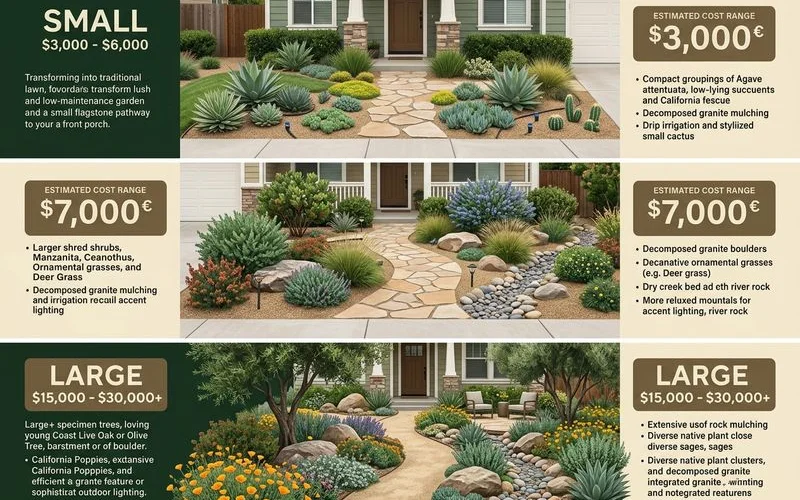
We see residential project prices average around $15 to $25 per square foot for a complete, high-quality transformation in 2026. Typical California design-build pricing ranges for a drought-tolerant install fall between $8,000 for a small front yard and upwards of $120,000 for estate properties. These baseline figures cover proper soil preparation, planting, drip irrigation, and finishing materials like mulch or decomposed granite.
Our crews install multi-zone irrigation systems to maximize water efficiency for every single client. A recent University of California study found that converting just 1,000 square feet of traditional turf to a water-wise design saves roughly 55,000 gallons of water annually. Hardscape integrations like paver patios or concrete walkways will add onto these standard baseline figures.
We base these ranges on design-build pricing from a licensed firm rather than piecemeal hourly labor.
| Yard size | Typical install cost | Notes |
|---|---|---|
| Small front yard (under 1,000 sq ft) | $8K to $18K | Plant palette + drip + mulch; rebate-eligible |
| Medium front or back (1,000 to 2,500 sq ft) | $18K to $45K | Often paired with a walkway or seat wall |
| Large back or full yard (2,500 to 5,000 sq ft) | $45K to $120K | Usually multi-zone with hardscape integration |
| Estate (5,000+ sq ft) | $120K+ | Multi-phase, full design-build, often with hillside work |
Design fee versus install split
We actively track component costs to ensure a transparent split between design fees and installation labor. Design fees usually range from $1,500 to $5,000, while the physical plant installation averages $4 to $10 per square foot. A typical landscape renovation naturally breaks down into distinct demolition, soil preparation, and planting phases.
Our project managers almost always credit a portion of the master plan fee toward the final installation cost. The upcoming 2027 state ban on watering non-functional commercial turf under Assembly Bill 1572 is currently creating a surge in demand for qualified landscape designers across the state. Smart irrigation controllers from brands like Hunter or Rachio cost about $200 to $300 for the hardware, but they remain absolutely essential for dialing in your specific watering zones.
- Design and master plan: $1,500 to $5,000 (often credited toward install)
- Demolition and lawn removal: $1.50 to $3.50 per sq ft
- Soil amendment and grading: $1 to $3 per sq ft
- Irrigation (drip + smart controller): $1.50 to $4 per sq ft (full rebuild)
- Plants (5-gallon mix): $4 to $10 per sq ft of planted area
- Mulch / decomposed granite finishing: $1 to $3 per sq ft
- Hardscape add-ons: priced per project (paver path: $18 to $45/sq ft; seat wall: $250 to $500/linear foot)
What pushes cost up
We advise clients to carefully weigh the visual impact of premium additions against their baseline budget. Retaining walls and steep slope grading easily represent the biggest cost multipliers for any landscape renovation. Upgrading to mature specimen trees or premium boulder placements will also quickly inflate the total price tag.
Our design team handles all necessary geotech and engineered drawings when your new walls exceed four feet in retained height. A mature 24-inch box Olive tree, for example, costs up to 10 times more than a standard 5-gallon sapling. Permitting costs have also become a significant factor in Los Angeles County, especially if your new hardscape exceeds the local impermeable threshold.
- Slope and hillside work. Terracing, retaining walls, and slope-specific irrigation can add $30K to $80K on a hillside lot.
- Full irrigation rebuild. Replacing an old spray-zone system entirely costs roughly $4K to $5K per zone.
- Mature specimen plants. Large 24-inch box specimens cost 10 times a 5-gallon equivalent.
- Premium material tier. Upgrading to large boulders, decomposed granite versus crushed gravel, and premium brass fixtures.
- Hardscape integration. Adding patios, walkways, and outdoor kitchens directly into the project layers.
- Permits. Hardscapes exceeding the impermeable threshold or walls over 4 feet in retained height require expensive handling, geotech testing, and engineered drawings.
What keeps cost down
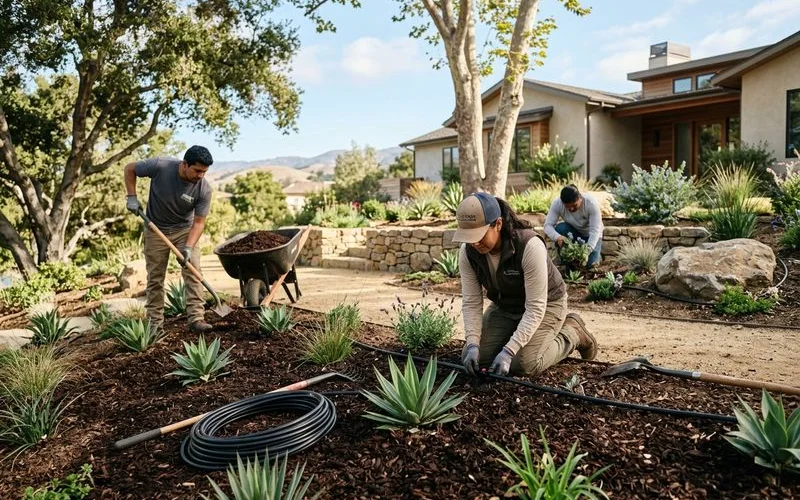
We highly recommend designing a full master plan today and phasing the physical installation over two or three seasons. Securing local water agency rebates is the single most effective way to lower your immediate out-of-pocket expenses. Installing smaller 1-gallon native plants instead of mature ornamentals also reduces your initial material bill significantly.
Our installation crews constantly look for ways to reuse existing PVC mainlines by converting them to low-pressure drip zones. The Los Angeles Department of Water and Power (LADWP) currently offers residential customers a generous turf replacement rebate of $5 per square foot for up to 5,000 square feet in 2026. Native California sage and poppy varieties establish deep root systems quickly, meaning those cheaper 1-gallon plants will catch up to larger sizes within a few short years.
- Phased install. Build the master plan once; install over two or three seasons. See phased landscape design.
- Smaller plant tier (1-gallon vs 5-gallon). Expect slower fill-in times but a much lower installation cost.
- Reuse existing irrigation infrastructure wherever the old pipes can be safely re-zoned for drip.
- MWD / LADWP rebate. You can get up to a few thousand dollars off qualifying conversions. See the LA turf replacement rebate guide.
- Native-heavy palette. Local native plants cost less than mature ornamentals and require far less water long-term.
Cost ownership over 10 years
We show property owners that a traditional lawn never breaks even on a financial comparison after the first three years of water bills. The true cost of a landscape project equals the initial installation fee plus a full decade of water and ongoing maintenance. A conventional grass lawn requires constant mowing, chemical fertilizers, and heavy watering, while a drought-tolerant yard mostly takes care of itself.
Our team has helped dozens of clients eliminate these recurring maintenance expenses entirely. According to recent 2026 landscaping industry data, drought-resistant setups reduce yard water consumption by 30 to 50 percent compared to traditional grass. The xeriscape cost california residents pay upfront is quickly offset by avoiding the $13,500 ten-year cost of maintaining a 1,500 square foot lawn.
- Lawn (1,500 sq ft): $0 install (“free”) + $9,000 water + $4,500 maintenance over 10 years = $13,500
- Drought conversion (1,500 sq ft): $25K install (less $3K rebate) + $1K water + $3K maintenance over 10 years = $26K
We remind clients that while drought conversions demand capital upfront, they protect you from predictably rising utility rates.
Where to start
We prefer to evaluate your specific property in person before providing final project estimates. A free on-site consultation is the only accurate way to put real numbers on a custom landscape renovation. The yard’s slope, soil composition, existing irrigation, and aesthetic preferences dramatically shift the total drought yard price ca properties require.
Our proven process ensures you know exactly what to expect before a single shovel hits the dirt. This is the exact role of Ridgeline’s drought-tolerant design service, focusing heavily on the design and budget tier first, and the installation second. You can rely on these early planning steps to secure the most competitive drought tolerant landscaping cost california market rates allow.
Frequently Asked Questions
What does a small drought front yard cost in California?
How much should I expect for the design fee?
What pushes cost up the fastest?
Have questions about a project of your own?
A free on-site consultation, a phased budget tier, and a master plan that fits your property and your goals.