Drought-Tolerant Landscape Design for Hillside Lots in LA
How to design a drought-tolerant landscape on a hillside lot in Los Angeles: slope-stable plants, terracing, erosion control, and drip irrigation on grades.
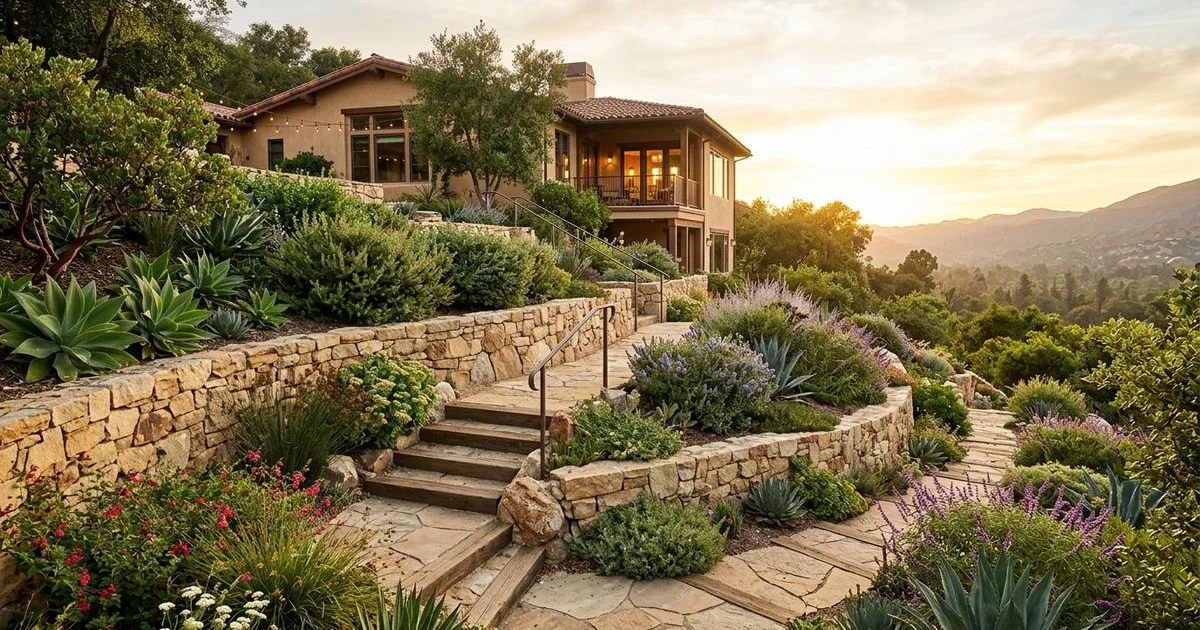
Hillside lots in La Cañada Flintridge, the Glendale foothills, Altadena, and the upper Pasadena foothills are some of LA’s best landscape opportunities. They are also some of the hardest environments to manage.
From what we see daily, managing water on these steep grades is the dividing line between a thriving landscape and a total washout.
Drought-tolerant design works beautifully on slopes when it is engineered for the terrain, rather than just sprinkled across it. Let’s look at the specific engineering, plant choices, and irrigation strategies our team uses to design a successful hillside drought tolerant landscape.
Why hillside drought design is its own thing
A flat-yard drought design assumes water sits where you put it. A hillside design has to assume the exact opposite.
Water concentrates downslope, taking valuable topsoil with it, while irrigation pressure varies wildly along the run. Studies by California resource conservation districts show that runoff on slopes exceeding a 33 percent grade can move 50 percent faster than on flat ground.
Here is a quick comparison of the two environments:
| Condition | Flat Yard | Hillside |
|---|---|---|
| Water Behavior | Sits and soaks evenly | Accelerates downslope rapidly |
| Soil Movement | Minimal migration | High risk of topsoil loss |
| Irrigation Focus | Simple saturation | Pressure compensation required |
We approach hillside design with a strict “slow it, spread it, sink it” methodology. Plants that thrive on a flat lot can easily wash out on a steep grade.
Conversely, plants that hold a slope might not thrive on flat, saturated ground. The species list, the spacing, and the irrigation engineering all have to change.
Slope-stable plant categories
These are the species our crews lean on for hillside drought work. Finding the right balance between drought resistance and deep root structures is critical when selecting hillside native plants LA residents can rely on.
A varied planting strategy is far more effective at stopping erosion than a single groundcover.
- Ceanothus (especially prostrate varieties): Deep roots provide fast slope cover. Varieties like ‘Yankee Point’ and ‘Joyce Coulter’ are workhorses. ‘Yankee Point’ can spread up to 10 feet wide, creating an evergreen blanket that ties the top two feet of soil tightly to the hillside.
- Manzanita (low-growing varieties): ‘Pacific Mist’ and ‘Emerald Carpet’ are excellent for groundcover. Taller varieties work well for distinct accents.
- Deer grass: This bunch grass features substantial root mass. It successfully holds soil between larger shrubs.
- California fuchsia (Epilobium canum): This perennial spreads gently via rhizomes and provides striking late-summer color. Once established, it is so drought-resistant it typically only requires supplemental watering once a month.
- Mediterranean shrubs: Rosemary, lavender, and sage work beautifully in mixed plantings. They have a less aggressive root mass than natives but add incredible texture.
- Toyon and laurel sumac: These are larger structural shrubs. They are perfect for upper terraces and slope crowns.
Terracing: when and how
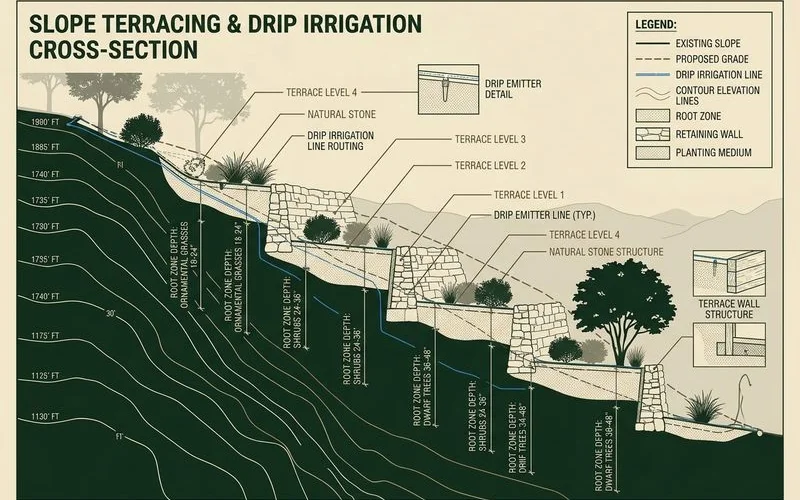
For slopes steeper than 25 to 30 percent, terracing is almost always the right answer. It transforms a hard-to-maintain hillside into a series of walkable benches, each planted to its own scheme.
Our retaining wall strategies prioritize both safety and budget. Two or three short retaining walls create highly functional terraces without unnecessary complications.
Here are the key permit thresholds for the Los Angeles area:
- Under 4 feet: Exempt from building permits if the wall is not supporting a surcharge.
- Over 4 feet: Requires full structural engineering and city permits.
- Any height supporting a driveway or structure: Mandatory permit required.
This 4-foot rule is why multiple short walls are vastly more economical than one massive structure. We routinely build taller engineered walls when needed, but staying under that municipal height limit saves thousands in fees.
For more on terracing specifically, see our detailed guide on hillside terracing in Los Angeles.
Drip irrigation engineering for slopes
Watering a hillside requires specialized equipment to fight gravity. Three major changes separate slope irrigation from flat-lot drip systems.
- Pressure-compensating emitters. Standard emitters over-water the bottom of a run and under-water the top. Pressure Compensating (PC) emitters, like those from Netafim, feature an elastic diaphragm that delivers a 100 percent uniform flow rate. They maintain this consistency across a massive pressure range, typically from 7 to 58 psi.
- Contour layout. Run laterals along contour lines at a constant elevation, rather than straight down the slope. This orientation is easier to balance and allows water to soak in laterally.
- More zones, shorter runs. Do not try to feed a 100-foot slope on one zone. Three to four shorter zones give you much better control and make maintenance significantly easier.
Our installation teams always map these zones based on sun exposure and soil type. This prevents the lower retaining walls from becoming waterlogged.
Erosion control planting
The first 12 to 18 months present the highest erosion risk while new plants establish their root systems. Bare soil on a steep incline is highly vulnerable to wind and heavy rain.
We typically deploy multiple layers of defense during this critical window to ensure proper slope erosion control planting.
- Apply jute or coir erosion-control matting on steeper slopes at the time of install.
- Top-dress with arbor mulch, laying down a full 3 inches over the matting. This thickness prevents the sun from drying the soil and stops topsoil from blowing away.
- Add a temporary cover crop in some cases. Clover or deer grass plugs provide fast root mass.
After establishment, the planted root system entirely replaces the matting’s function. The deep roots of native plants act like natural rebar for the hillside.
If you are still mapping out your project, our guide on california Native Plants for Los Angeles Yards covers a related angle that pairs well with this topic.
Bridging to the structural work
Most hillside drought projects pair planting with either retaining walls, terracing, or hillside drainage work. A successful project requires drawing the planting plan and the structural plan together.
The toe of a wall is exactly where French drain discharge fits best. The upper bench is where deep-rooted shrubs hold the new grade securely.
“A planting plan is only as strong as the drainage system supporting it.”
Our approach ensures these systems support one another from day one. That deep integration is the core of Ridgeline’s drought-tolerant design service, built specifically for the unique challenges of LA’s foothill belt.
Starting with a cohesive plan saves you from ripping up fresh landscaping to fix a drainage issue later. Contact our office to schedule a site evaluation and begin planning your hillside transformation.
Frequently Asked Questions
Best drought-tolerant plants for slopes?
Do I need terraces?
Will drip irrigation work on a hill?
Have questions about a project of your own?
A free on-site consultation, a phased budget tier, and a master plan that fits your property and your goals.