Phased Landscape Design: Budgeting and Installing in Stages
How to plan a landscape master plan once, then install in 2–4 phases over multiple seasons. Budget tiers, common splits, and how to keep the design coherent.
You know how people assume a stunning, sustainable yard requires a massive, upfront cash investment? That assumption keeps many homeowners stuck with outdated, water-wasting lawns.
The reality is much more manageable.
We founded Ridgeline Outdoor Living with a simple mission: to provide exceptional landscaping and hardscaping services that customers can truly rely on. From what we see every day, phased landscape design is how most $100K+ residential projects actually get built. Let’s look at the data, what it actually tells us about budget pacing, and then explore the exact strategies that make staging successful.
Why phasing makes sense
The choice to break a large project into stages provides clear, practical advantages. Three specific reasons drive this strategy:
- Budget calibration. A $200,000 vision is a heavy financial commitment for a single season. Breaking that into three $70,000 phases over three years makes financing much easier to secure. Recent 2026 data from Techo-Bloc contractor surveys shows a mid-range paver patio alone averages $17,750, making staging a smart financial tool.
- Disruption pacing. A full-property rebuild takes three to six months of heavy construction. Our crews work efficiently, but heavy machinery is undeniably loud. Some families want the dirt concentrated into one summer, while others prefer smaller installations spread out over time.
- Design discovery. A phase-three planting palette sometimes only becomes obvious after living with the first phase for a year. Staging the work leaves room to refine plant choices based on how the yard actually performs.
The non-negotiable: master plan first
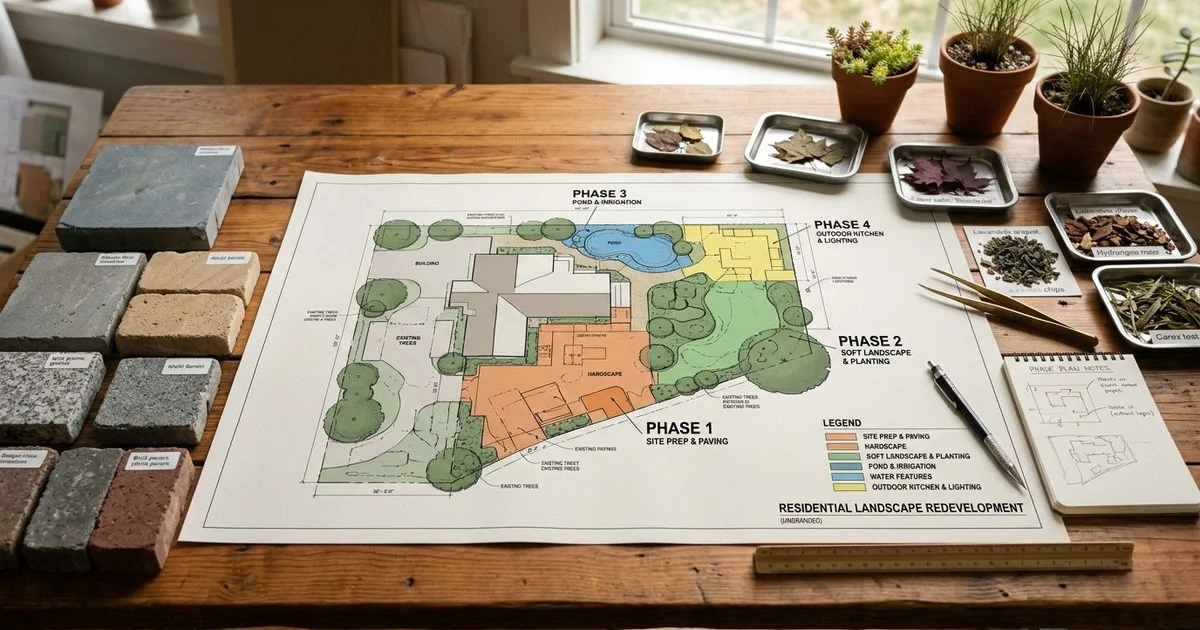
The biggest mistake you can make when you stage landscape installation is starting physical work before finalizing the master plan. Rushing into phase one without a blueprint hard-codes permanent constraints that ruin phase three.
Our signature Ridgeline master plan acts as the blueprint for every future decision. It comprehensively covers:
- Final grade and structural drainage routing
- All hardscape footprints, including patios, retaining walls, and walkways
- Planting plans built around specific hydrozones to minimize water usage
- Irrigation routing using smart tech like the Rachio 3 controller
- Exact lighting fixtures, paver brands, and plant species
With that document in hand, every single phase contributes perfectly to the same future yard. A 2025 review of smart controllers found that using systems like the Rachio 3 saves up to 50% on outdoor watering. Planning for these specific upgrades early ensures the plumbing is ready when you finally install them.
Common phasing splits
The correct sequence depends heavily on the specific property. Certain patterns repeat frequently across successful residential projects.
Front yard, then back yard
The front yard often goes first because curb appeal and water savings generate immediate returns. California residents have a huge incentive right now, with the SoCal WaterSmart turf replacement rebate offering up to $7 per square foot. Applications must be submitted by February 2026 to lock in that maximum rate. The larger backyard investment, like a pool or pergola, then follows in phase two.
Hardscape, then softscape
All the heavy structural work happens at the same time to limit trenching and earthmoving to a single event. This means retaining walls, paver patios, drainage, and the outdoor kitchen are built simultaneously. Planting and low-voltage lighting are layered in afterward.
Structure, then planting, then features
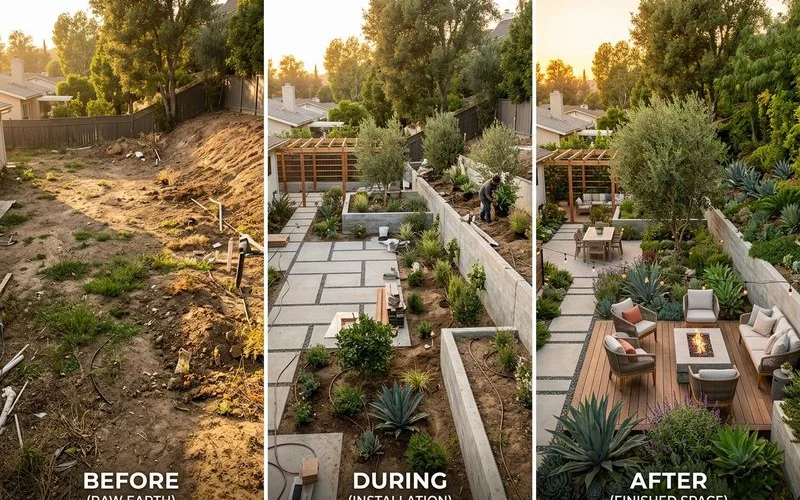
Our design team frequently splits projects into three distinct waves. Phase one handles the messy work like grading, drainage, block walls, and irrigation rough-ins. Phase two brings the space to life with finish hardscape and drought-tolerant planting. Phase three introduces the luxury elements, such as a custom fire pit or a water feature.
Budget-staging examples
Every site is unique, but looking at real numbers helps clarify the landscape in phases budget process. A typical Ridgeline financial breakdown follows a few common paths.
- $30K / $30K / $30K over three years. Year one tackles a front-yard drought conversion to capture state rebates. Year two funds the back-yard patio and planting, while year three finishes with the outdoor kitchen and pergola.
- $70K / $50K / $30K. The primary hardscape and softscape are built together during the first push. The kitchen build-out follows in year two. The final phase focuses on lighting and advanced irrigation refinement.
- $120K / $80K. Structural engineering and the entire front yard happen in one summer. The extensive outdoor living build, including a kitchen and custom fire pit, completes the vision the next year.
We highly recommend connecting with local rebate program staff before finalizing your year-one budget. Securing those funds early drastically alters how much you can afford in later stages.
Locking phase one without locking phase three
Most homeowners want a firm commitment on phase one pricing without trapping themselves into a rigid spec for the future. Material costs fluctuate wildly, making a three-year fixed bid impossible.
Our administrative process solves this problem elegantly. The standard approach is to lock the phase one contract immediately while holding a binding design retainer that covers all future stages. This allows us to re-spec the materials for phases two and three right before their respective installations begin. Honest adjustments are made for market changes, ensuring no one gets penalized by unexpected inflation.
When phasing isn’t the right answer
Staging a project does not always equal saving money. Projects budgeted under $40,000 to $50,000 usually suffer when broken apart.
Mobilization fees, equipment rentals, and minimum daily labor charges eat up a massive portion of small, split budgets. Engineering a hillside property provides a perfect example of this limitation. Phasing the structural work for engineered retaining walls or permitted hardscape piecemeal is almost always more expensive than pouring it all at once. The economy of scale disappears when the concrete trucks have to make three separate trips.
If you are still mapping out your project, our guide on california Native Plants for Los Angeles Yards covers a related angle that pairs well with this topic.
Where this fits
Phased landscape design remains the default option for a majority of Ridgeline projects. We scope most of our larger builds, specifically those exceeding $75,000, with at least one clean split.
Many of these properties run successfully as two- or three-season builds. Our drought-tolerant design service is the natural starting point for this journey. You design the master plan once, capture the available water-saving rebates, and install the beautiful results in manageable stages.
Start by assessing your current yard and dreaming up the ultimate master plan today.
Frequently Asked Questions
Can we install our project in phases?
Do phased prices change?
What should phase one usually cover?
Have questions about a project of your own?
A free on-site consultation, a phased budget tier, and a master plan that fits your property and your goals.