LA Water Rebates and the Turf-Replacement Incentive (How to Qualify)
Current MWD and LADWP turf-replacement rebate rules, qualifying plant lists, square-footage thresholds, and how a contractor handles the paperwork.
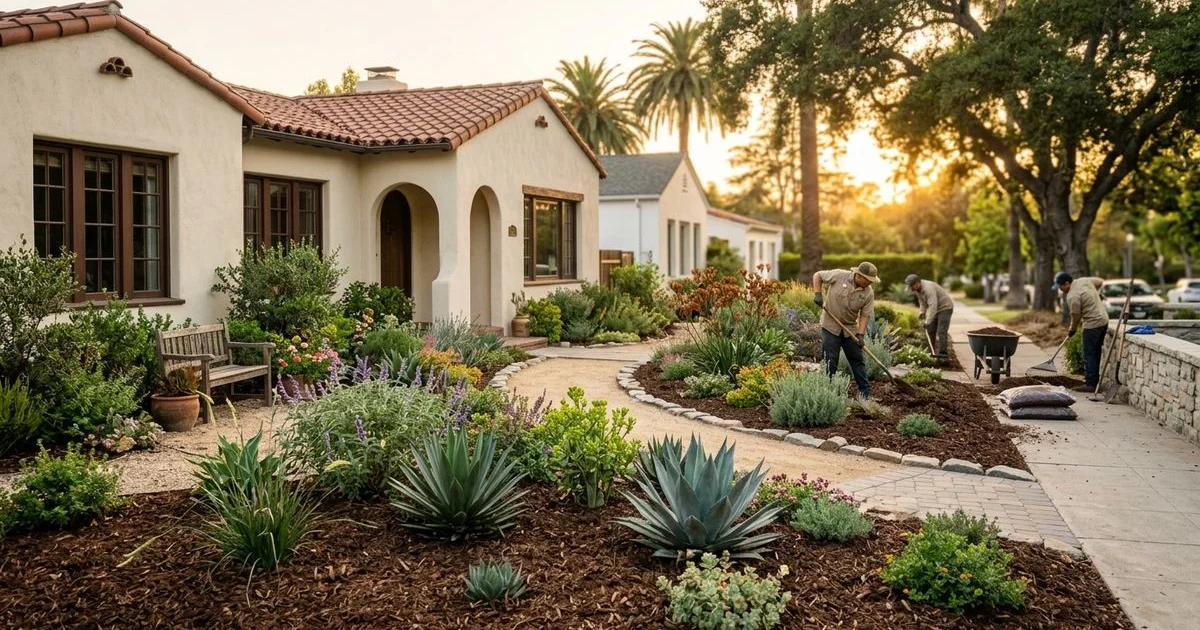
We see the MWD turf-replacement rebate as a quiet driver of drought conversions across Pasadena, Glendale, and the rest of LA’s primary water districts for over a decade.
This la turf replacement rebate is real money.
Our team regularly helps clients secure anywhere from a few thousand dollars on a small front yard to five figures on a larger landscape conversion. Qualifying for the rebate can offset a meaningful portion of your installation costs. We will explain the core requirements and show you exactly how to navigate the application successfully.
Who runs the rebate
The Metropolitan Water District of Southern California (MWD) is the regional wholesaler funding the core turf-replacement program. This massive agency serves 26 member districts across the region and manages the baseline funding. We usually direct LA-area homeowners to apply through the official SoCalWaterSmart portal. The system then routes your application to your specific local utility, such as LADWP, Pasadena Water and Power, or Glendale Water and Power.
Our clients often benefit heavily from layered local incentives. For example, while the base mwd turf rebate provides $2 per square foot, the ladwp lawn rebate often adds another $3. That local addition brings your total potential refund to an impressive $5 per square foot.
Base mechanics
The rebate pays a direct, per-square-foot dollar amount for the live grass area you remove and replace with qualifying drought-tolerant landscaping. You must meet specific site and design criteria to secure these funds. We ensure every design hits the mandatory threshold of at least three approved plants per 100 square feet of transformed area. Current municipal requirements also mandate a dedicated stormwater retention feature, like a vegetated swale or a rain garden, to capture runoff. Our design process incorporates these rules automatically.
As of this guide’s 2026 writing, the core structure includes:
- Pre-inspection required. You must apply with the lawn still in place. An inspector or remote photo verification confirms the existing green condition.
- Per-square-foot rebate. Payments are strictly calculated on the approved replacement area.
- Square-footage limits. Residential projects typically face a minimum requirement of 250 square feet and a maximum cap of 5,000 square feet.
- Approved plant list. California natives, low-water Mediterranean shrubs, and climate-appropriate groundcovers all qualify. You can consult the California Native Plant Society’s Calscape database for eligible options.
- Permeable surface minimums. A significant portion of the replaced area must be planted, meaning you cannot cover the yard entirely in aggregate or hardscape.
- Post-install verification. Final payout requires photo or in-person verification to confirm the installation matches the approved plan.
Specific dollar amounts and caps change with drought conditions and the annual program budget. We always confirm the most current local rates during your initial consultation.
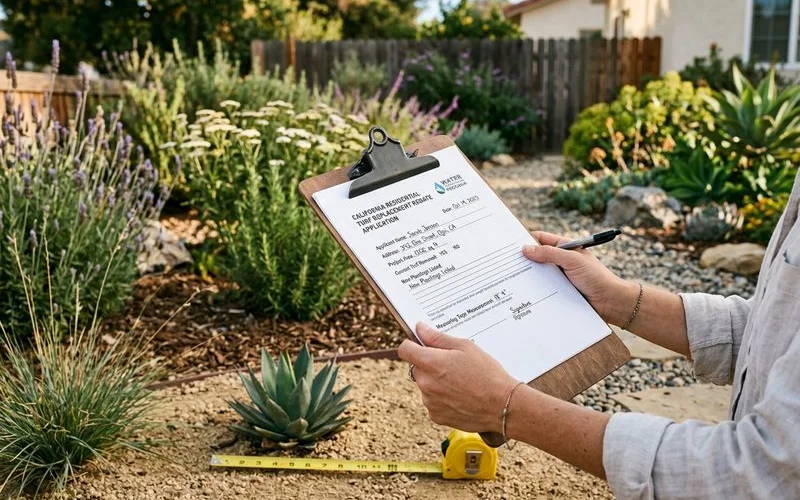
Application process
You must submit all paperwork and receive official pre-approval through the SoCalWaterSmart portal before a single blade of grass is removed. Starting demolition early is the fastest way to forfeit your funding. We guide homeowners through this timeline to prevent costly mistakes. Local agencies like LADWP typically take 4 to 6 weeks to process and approve the initial application.
- Apply before any work begins. The application must be filed and pre-approved with the lawn completely intact.
- Submit project documentation. This package includes detailed sketches, clear photos, accurate square-footage measurements, and a complete plant list.
- Wait for pre-approval. Your application triggers a specific window once approved, usually giving you 180 days to finish the installation.
- Install. Tear out the lawn and build the new design according to the approved plan.
- Submit completion documentation. You must provide post-install photos, actual plant receipts, and the final measured square footage.
- Wait for inspection or verification. Some utilities verify the work in person, while others rely entirely on photo verification.
- Rebate is paid. You can expect the final check in 8 to 16 weeks from final submission, depending on your specific utility’s backlog.
How a contractor supports the paperwork
A professional contractor manages the rigid design constraints and application details so you do not have to. Trying to qualify turf replacement la projects without experience often leads to rejected site plans and delayed approvals. We handle the entire rebate process for our clients in three distinct parts. This hands-on approach minimizes errors and maximizes your eligible return.
- Design to rebate criteria. The plant palette, the planted-area percentage, and the required irrigation modifications are all designed to qualify before we submit anything.
- Application support. We provide the technical documentation, including CAD plans, measurements, and pre-site photos, to help fill the portal application. The homeowner remains the named applicant on the final rebate.
- Inspection coordination. We stay on-site for the verification visit if needed, and we compile all the mandatory post-install documentation for the final upload.
What disqualifies a project
Breaking the strict timeline or failing to meet the minimum vegetation requirements will immediately disqualify your project. Water districts are incredibly rigid about enforcing these boundaries. Our team reviews every proposal to ensure no restricted materials make it into the final build. For instance, the MWD explicitly bans synthetic turf and artificial grass from receiving any rebate funds.
Common reasons for application denial include:
- Any lawn removal or physical turf modification before the application is officially approved.
- Replacement with concrete, artificial turf, or other non-qualifying impermeable surfaces.
- Failure to plant the space to the minimum live-coverage threshold of three plants per 100 square feet.
- Missing the strict 180-day install window after receiving pre-approval.
- Neglecting to include a required stormwater capture feature in the submitted design plan.
Where this fits in cost planning
The rebate offsets a fraction of the total installation cost rather than covering the entire project. A standard conversion requires the same professional design and labor whether you apply for the funds or not. We usually recommend the same drought conversion either way, but the refund certainly changes the math. A $25,000 front-yard conversion on a 1,000-square-foot lawn might net $2,000 to $3,000 back from the base MWD program. Our larger 2,500-square-foot conversion projects often see the rebate land in the $5,000 to $8,000 range when local incentives are factored in.
Understanding the broader financial picture helps you set a realistic budget for your property. For full state-level cost framing, see drought-tolerant landscaping cost in California. We structure every eligible project to maximize these returns. For the design service that runs through rebate qualification on every eligible project, see Ridgeline’s drought-tolerant landscape design.
Frequently Asked Questions
How much is the rebate per square foot?
Do I have to apply before installing?
Can artificial turf qualify?
Have questions about a project of your own?
A free on-site consultation, a phased budget tier, and a master plan that fits your property and your goals.