Drought-Tolerant Landscaping vs Artificial Turf (LA Comparison)
Side-by-side comparison of drought-tolerant landscaping vs artificial turf for LA yards: cost, water, maintenance, longevity, environment, and when each wins.
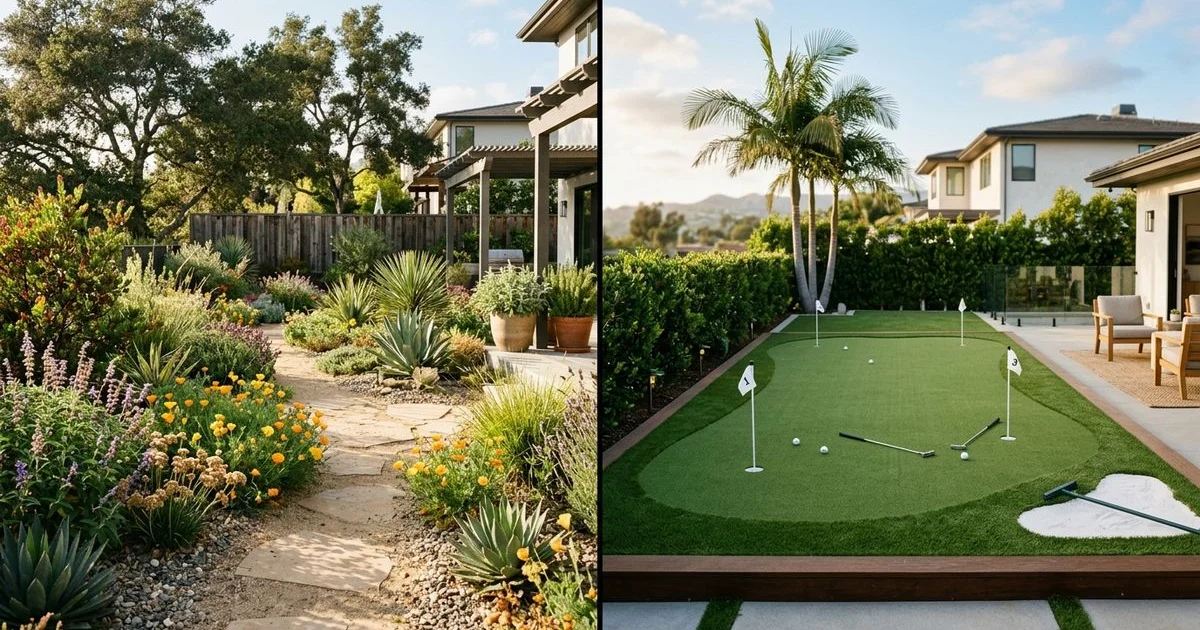
Our team at Ridgeline Outdoor Living founded this company to provide exceptional landscaping that Southern California customers can truly rely on. The debate of drought-tolerant planting vs premium artificial turf usually comes down to practical daily use.
We know both options offer fantastic, long-lasting solutions for your property.
A typical 1,000-square-foot lawn replacement saves roughly 12,000 gallons of water per year. Our goal is to help you compare drought tolerant landscaping vs artificial turf based on your habits. Let’s look at the data to see how xeriscape vs turf compares, and how to plan your space effectively.
Quick comparison
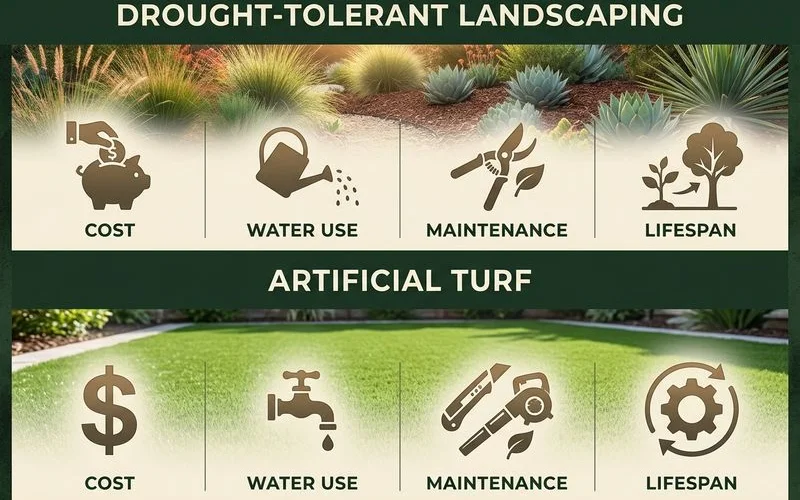
We always start consultations by looking at the hard numbers. This side-by-side breakdown highlights the core differences between a fake grass vs drought yard setup.
| Dimension | Drought planting | Artificial turf |
|---|---|---|
| Install cost | $4 to $10 per sq ft (planted area) | $8 to $18 per sq ft installed |
| Water (year 3+) | Minimal (50 to 80% reduction) | None |
| Maintenance | Seasonal pruning, mulch top-up | Brushing, infill top-up every 5 to 8 years |
| Lifespan | Native plants live 15 to 40+ years | 12 to 20 years |
| Heat in LA sun | Cooler (typical leaf canopy 80 to 95°F) | 130 to 160°F surface temp |
| Pollinator habitat | Significant (manzanita, sage) | None |
| Rebate eligible | Yes (Up to $5 per sq ft via LADWP) | No |
| Pet-friendly | Some plants risky for chewers | Excellent with antimicrobial ZeoFill |
| Kid play surface | Acceptable not ideal | Excellent |
Where drought wins
Our landscape architects love designing native gardens because they actively restore the local ecosystem. A well-planned xeriscape can cut your household water consumption by up to 80 percent.
We frequently install California sage and manzanita to create a vibrant pollinator habitat. These specific plants thrive in the Los Angeles climate while requiring almost zero supplemental irrigation by year three.
- Front yards prioritizing aesthetic appeal and local pollinator habitats.
- Households without heavy pet traffic or daily rough play on the grass.
- Hillside lots where natural slope drainage strongly favors deep-rooted plants over synthetic bases.
- Properties qualifying for the generous LADWP residential turf replacement rebate (currently up to $5 per square foot).
- Any project where year-three character, seasonal blooming, and natural shade matter.
Where artificial turf wins
We recommend synthetic grass for active families who need a highly durable, mud-free play area. Modern synthetic lawns withstand heavy daily use without developing brown patches.
Our installation crews use specialized infills like ZeoFill to keep these spaces sanitary. Zeolite minerals trap ammonia from pet urine, which is crucial for odor control during hot Los Angeles summers.
- High-traffic dog yards requiring durable surfaces and easy waste cleanup.
- Backyards heavily used for kids’ soccer practice or daily sports.
- Custom backyard putting greens built for golf enthusiasts.
- Northern exposures or deep shade areas under large trees where natural grass or sun-loving natives struggle.
- Households that want predictability and a uniform green look year-round.
10-year ownership math
We always run a decade-long cost projection to give clients a clear financial picture. A standard 1,000-square-foot lawn replacement at typical Los Angeles prices reveals interesting long-term trends.
Our calculations show that rebates heavily influence the final return on investment. Here is how the financial breakdown typically looks over a decade.
- Drought planting: $5,500 initial install plus roughly $300 per year for water and minor maintenance totals about $8,500 over 10 years. A $5,000 LADWP residential rebate brings the net cost down to $3,500.
- Premium artificial turf: $12,000 initial install plus minimal maintenance costs equals roughly $13,000 over 10 years, with no utility rebates available to offset the price.
We find that native planting easily wins the long-term financial battle. The cost gap narrows on small patches and reverses entirely on heavy-use sports spaces where natural grass would require constant replanting.
A common Ridgeline answer: hybrid
Our most successful Los Angeles projects often feature a combination of both approaches. A hybrid design maximizes the benefits of each surface while minimizing their respective downsides.
We usually design the front yard with drought-tolerant species to secure the LADWP rebate and boost curb appeal. The backyard then gets a premium synthetic turf installation for the dog run or kid play zone.
Our designers frame that synthetic play area with a deep border of native California shrubs. This strategic layout gives a property three distinct advantages:
- Lower overall surface temperatures in the backyard.
- Maximum financial return through partial rebate qualification.
- Dedicated zones for both wildlife support and active family use.
If you are still mapping out your project, our guide on california Native Plants for Los Angeles Yards covers a related angle that pairs well with this topic.
Which decision do you actually have to make
We tell homeowners that the final choice really depends on the specific zone of the property. Visual spaces like front lawns lean heavily toward native plants, while daily play surfaces demand the resilience of synthetic materials.
Our design consultation process focuses on mapping out these specific use areas.
A typical Los Angeles property lands somewhere in the middle, requiring a strategic mix of both treatments. We run both drought design and artificial turf installation teams in-house to handle this exact balancing act. Book a consultation today to claim your available LADWP rebates before funding runs out.
Frequently Asked Questions
Which costs more upfront?
Which is hotter in LA summer?
Which is better for pets and kids?
Have questions about a project of your own?
A free on-site consultation, a phased budget tier, and a master plan that fits your property and your goals.