Why Retaining Walls Fail (And How to Avoid It)
The three reasons retaining walls fail — undersized footings, missing drainage, wrong wall type — and how proper engineering avoids each.
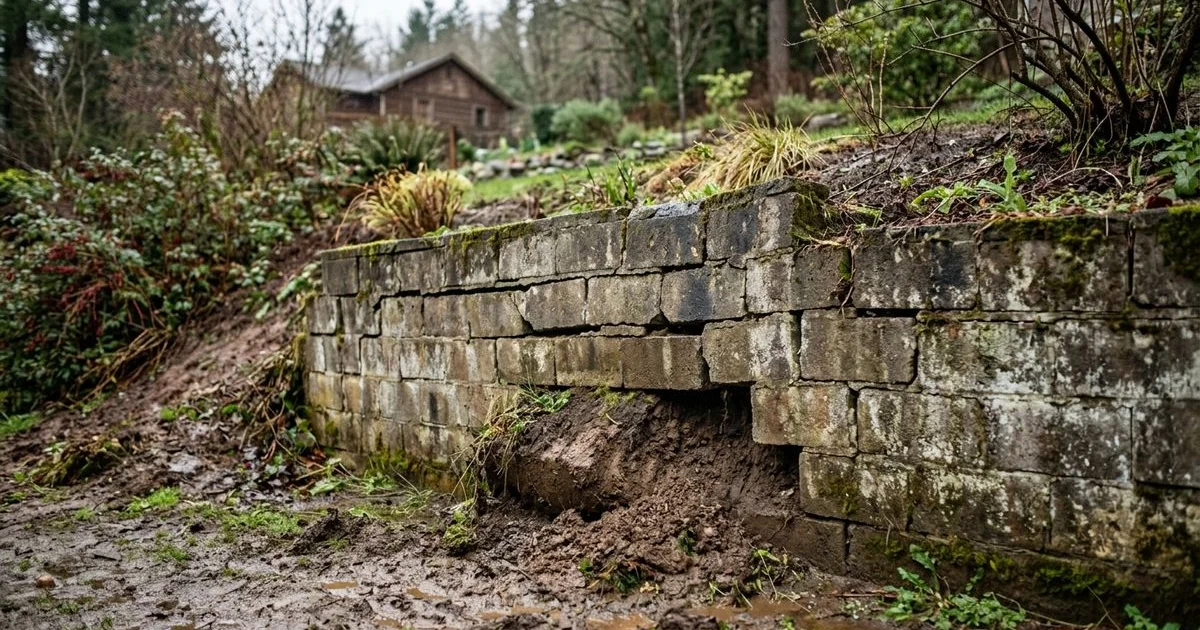
Our team at Ridgeline Outdoor Living regularly inspects hardscaping projects across California.
Sudden winter storms often expose hidden structural flaws in drought-stressed yards.
We see the exact same preventable mistakes repeating themselves in collapsed and leaning structures every season.
If you ever ask yourself why do retaining walls fail, a 2026 review of local landscape incidents reveals that three specific engineering choices account for nearly every collapse. Our goal is to help you spot these issues before they become expensive hazards.
The good news is that none of these collapses are random or unlucky.
We will break down the three primary reasons these structures fail and walk through the exact prevention strategies you need. You can easily avoid these common pitfalls during the design phase.
Failure mode 1: Undersized footing
A retaining wall transfers all the load from the retained soil down through its footing into the underlying earth. If this foundation is too small or shallow, the ground simply cannot carry the heavy burden. We often find that inadequate bases cause these structures to settle, tip, or crack right at the bottom.
In California, the building code requires a minimum footing depth of 12 inches below untouched soil to ensure stability. Frost lines are rarely a concern for local homeowners, but achieving the correct embedment depth is mandatory for structural safety. Our engineers calculate this depth based on the specific bearing capacity of your property’s soil. A wall taller than four feet legally requires a licensed professional to design this foundation.
Common Signs of Footing Failure
You will usually notice a foundation problem developing slowly over time.
- The entire structure begins leaning forward visibly.
- Cracks develop near the very bottom of the face material.
- New settlement appears that was not present during the initial installation.
- These warning signs typically emerge within the first two to five years.
How to Prevent Foundation Settlement
Proper prevention comes down to strict adherence to geotechnical recommendations. We always size the footing perfectly to match the load requirements and soil conditions on site. The local structural engineer dictates these dimensions for permitted projects to guarantee long-term stability.
Failure mode 2: Missing or undersized drainage (the most common cause)
The soil behind your landscape feature acts like a giant sponge during our wet winter seasons. Without a clear drainage path, accumulated water creates massive hydrostatic pressure against the back of the blocks. We consider this invisible force the absolute leading cause of a catastrophic retaining wall blow out. A fully saturated backfill can easily double the lateral force pushing outward.
Drought-conscious homeowners often install efficient irrigation systems, but intense seasonal rains will still overwhelm a poorly drained structure. Using native clay soil as backfill is a frequent mistake because it traps moisture instead of letting it flow, leading directly to a retaining wall failure. Our crews remove this dense clay and replace it with engineered gravel to ensure rapid water movement.
Recognizing Drainage Problems
Water always finds a way out, and it leaves obvious clues behind.
- The center of the installation bulges outward noticeably.
- Face materials crack, pop, or completely detach.
- Muddy water seeps directly through the front joints.
- Damage appears suddenly after the first heavy rainstorm of the year.
Mandatory Prevention Methods
Every successful installation requires a two-part defense system against water buildup.
- French drain at the toe: A perforated pipe sits in a graded gravel envelope behind the blocks. Installers wrap this pipe in geotextile fabric and slope it toward a safe discharge point.
- Weep holes through the face: Small exit points placed every four to six feet allow bypass water to escape. This prevents liquid from getting trapped if the primary French drain ever reaches capacity.
We treat these drainage elements as absolute necessities for any engineered structure. Walls built without proper water management are literal time bombs waiting for the next major storm.
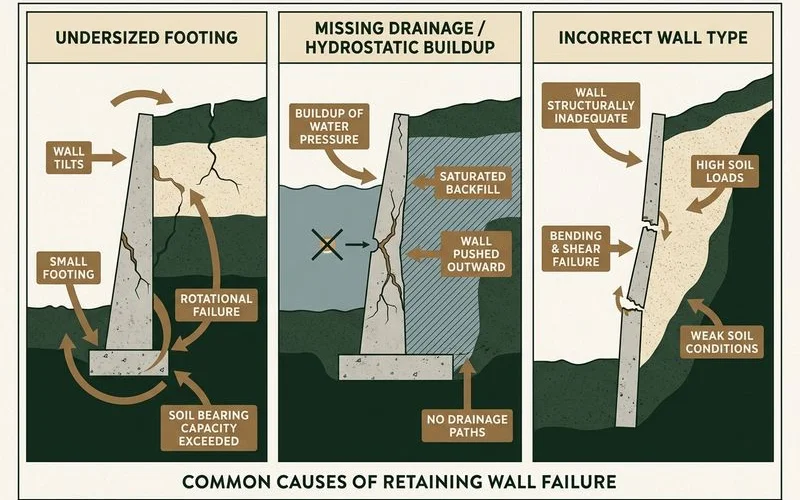
Failure mode 3: Wrong wall type for the conditions
Selecting the incorrect building material for your specific site conditions guarantees eventual failure. A standard segmental block system works perfectly for a low residential terrace, but it cannot support a heavy driveway surcharge. We analyze the retained height and soil type before ever recommending a specific construction method.
California residents must account for frequent seismic activity and highly variable soil composition. Segmental blocks offer excellent flexibility during ground movement compared to rigid poured concrete. Our design team carefully evaluates these environmental factors to select the most resilient option for your property. An incorrect choice will slowly buckle under the constant pressure.
The Slow Progression of Distress
Using the wrong structural type rarely results in an overnight collapse.
- Vertical and horizontal joints begin widening.
- Individual face materials rotate out of alignment.
- Small localized failures occur in the weakest sections.
- The entire structure eventually tips past the point of repair.
Making the Right Material Choice
You must perfectly match the chosen material to the retained height and the anticipated surcharge load. A licensed structural engineer handles this critical decision for all permitted projects. We always rely on experienced design-build contractors to determine the safest approach for smaller garden features under the permit threshold.
| Material Type | Best Application | Key Benefit |
|---|---|---|
| Segmental Block | Terraces under 4 feet | Flexibility during minor seismic shifts |
| Poured Concrete | Tall heights or heavy loads | Maximum structural rigidity |
| CMU (Cinder Block) | Property line dividers | Cost-effective engineered strength |
For more details on choosing the ideal fit, see our detailed resources on types of retaining walls and engineered concrete vs segmental options.
What “properly engineered” actually means
A properly engineered installation requires precise calculations to ensure stability against overturning and sliding. The California Building Code mandates a minimum safety factor of 1.5 for these lateral forces. We build every single project to meet or exceed these rigorous structural requirements.
Skipping just one of the following requirements introduces a permanent defect into the foundation. A flaw might not cause immediate problems, but it creates a dangerous weak point. Our crews know that stress always concentrates in these defective areas during heavy rains or minor earthquakes.
The Seven Pillars of Stability
A structure built to last will include every single one of these components.
- Footing sized for the bearing soil: Dimensions informed by a geotechnical report for permitted projects.
- Wall stem sized for the load: Backed by professional engineered drawings and a strict reinforcement schedule.
- Drainage at the toe: A dedicated French drain encased in a clean gravel envelope.
- Weep holes through the face: Clear escape routes for trapped moisture.
- Compacted backfill: Placed carefully in measured lifts rather than dumped all at once.
- Targeted reinforcement: Geogrid layers for segmental blocks or thick rebar for CMU and poured concrete.
- Thorough construction inspection: Required at the footing pour, during stem reinforcement, and at final completion.
When you can spot trouble early
You can save thousands of dollars in replacement costs by identifying structural distress early. A lean of just one or two degrees represents a massive 15 to 20 percent reduction in overall load-bearing capacity. We urge property owners to monitor their landscapes closely after periods of intense drought followed by heavy rainfall.
Once a structure reaches a five to seven-degree lean, it enters the dangerous zone of imminent collapse. Replacing a failed system in California averages between $300 and $900 per linear foot in 2026. Our intervention methods can sometimes save a slightly distressed installation before it requires full demolition.
Critical Warning Signs
Any installation built within the last five years that displays these symptoms requires immediate attention.
- Visible outward leaning easily detected with a simple string-line check.
- Horizontal cracks spreading across the primary face material.
- Muddy soil actively seeping through mortar joints or dry-stack gaps.
- Bulging anywhere along the middle sections of the barrier.
- Dark water stains suggesting a completely failed drainage system.
Caught early, professionals can sometimes stabilize the shifting earth using heavy-duty soil nails or deep deadman anchors. Ignored for too long, the entire mass will need to come down and be completely rebuilt from scratch.
That exact engineering and construction discipline forms the foundation of Ridgeline’s dedicated retaining walls service. Every project is carefully designed for actual site conditions, drained properly, and built to withstand the test of time.
Understanding exactly why do retaining walls fail allows you to make smarter choices for your property. Reach out to schedule a comprehensive site evaluation before the next storm season arrives.
Frequently Asked Questions
What's the most common reason retaining walls fail?
Can a leaning retaining wall be saved?
How long should a properly built retaining wall last?
Have questions about a project of your own?
A free on-site consultation, a phased budget tier, and a master plan that fits your property and your goals.