Paver Patio Cost in California (2026 Guide)
Real California paver patio costs by size and material tier — concrete pavers, travertine, porcelain — plus base prep, edge details, and design fee breakdown.
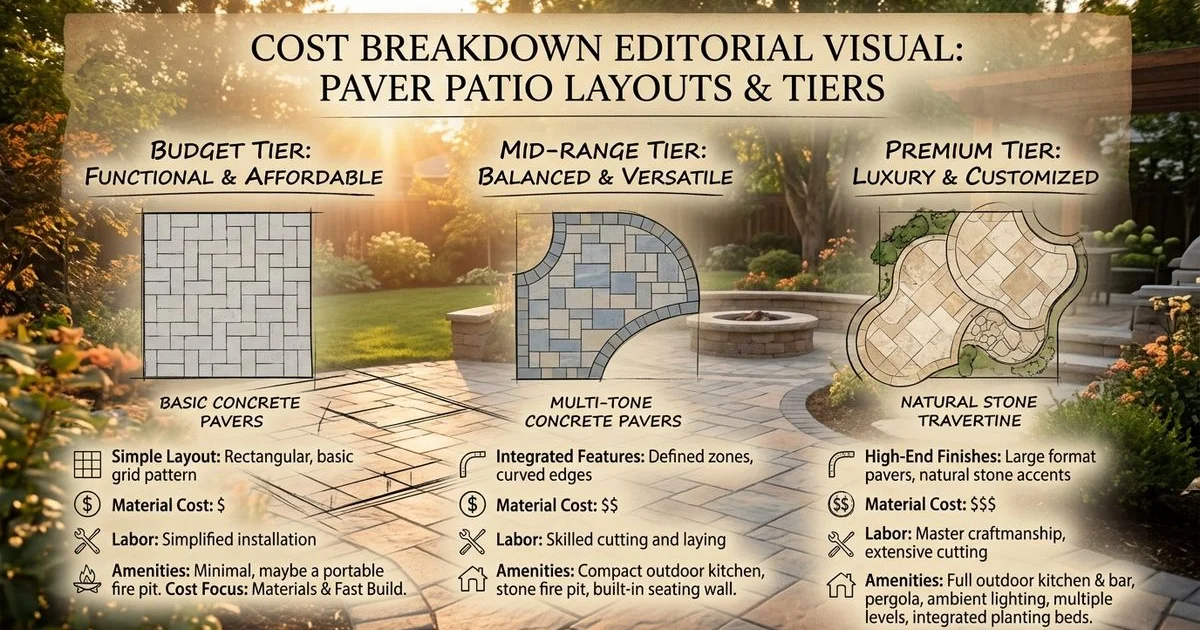
A 2026 paver patio cost in California ranges anywhere from $18 to $45 per square foot installed. Prices fluctuate based on your material choices, base requirements, and the complexity of your outdoor project.
We see this pricing variance every day on local job sites. Figuring out an honest budget is much easier when you know exactly what contractors are paying for materials and labor.
This specific breakdown shows where your money actually goes.
We want you to be fully prepared for your next consultation. Reviewing current market rates reveals exactly how proper installation changes the final price tag.
Cost ranges by yard size
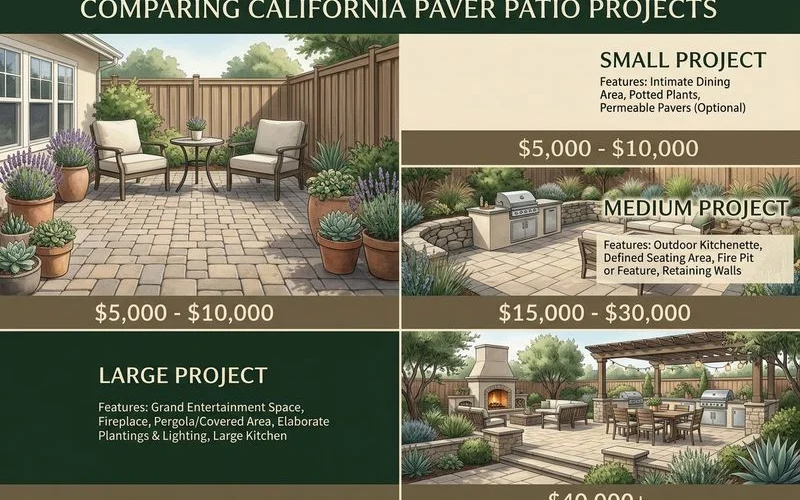
Small 200-square-foot patios start around $4,500 for standard pavers, while expansive 800-square-foot luxury porcelain layouts can exceed $48,000. These totals depend heavily on your material selections and the required base preparation.
We use design-build pricing from a licensed contractor to set these baseline expectations. Recent 2026 data shows that a standard CA paver patio price consistently ranges from $12 to $30 per square foot for the base installation.
A cheaper quote almost always indicates skipped steps like shallow excavation or missing edge restraints. You will usually see these budget patios fail or sink within five years.
| Patio size | Standard concrete pavers | Premium concrete / travertine | Large-format porcelain |
|---|---|---|---|
| Small (200 sq ft) | $4,500 to $6,500 | $7,000 to $9,500 | $9,000 to $12,000 |
| Medium (400 sq ft) | $9,000 to $13,000 | $13,000 to $18,000 | $17,000 to $24,000 |
| Large (800 sq ft) | $18,000 to $26,000 | $26,000 to $36,000 | $34,000 to $48,000 |
| With seat walls / steps | Add $3,000 to $15,000 | Add $4,000 to $20,000 | Add $5,000 to $25,000 |
Where the money goes
Most of your budget covers materials at 30 to 40 percent, while installation labor takes another 20 to 30 percent. The remaining funds pay for necessary site preparation, base aggregates, and local permit fees.
We divide the total expenses into three distinct categories to make the budgeting process clearer. Each phase requires specific materials and expert handling to ensure longevity.
Materials and Installation Labor
Standard concrete blocks from brands like Angelus cost $4 to $8 per square foot just for the units. Premium options like large-format porcelain can push material prices to $15 or $25 per square foot.
We notice that labor costs stay relatively steady across different materials. Paying an installation crew typically adds $8 to $14 per square foot to your total bill. Complex layouts increase that labor rate quickly.
Expect these typical labor add-ons for custom patterns:
- Herringbone patterns: Add $2 to $4 per square foot.
- Versailles layouts: Add $3 to $5 per square foot.
- Custom circular fans: Add $4 to $6 per square foot.
Site Preparation and Sub-base
Demolishing your old concrete and hauling it away costs $1 to $3 per square foot. Proper base preparation using gravel and sand requires an additional $2 to $6 per square foot.
We consider this the most critical phase of any hardscape project. Skipping a deep excavation causes paver sinking and costly future repairs. A solid sub-base aggregate guarantees your patio stays flat and drains properly during heavy winter rains.
Essential Finishing Elements and Fees
Edge restraints, polymeric sand, and local permits account for the final 5 to 15 percent of your total budget. Filling joints with high-quality polymeric sand costs roughly $0.50 to $1.50 per square foot.
We always include these finishing touches because plain mason sand washes out immediately. City permit fees vary widely across California municipalities.
Standard project fees usually include:
- Polymeric sand applications: $0.50 to $1.50 per square foot.
- Edge restraint systems: $2 to $4 per linear foot.
- Standalone design plans: $1,500 to $5,000 upfront.
What pushes cost up the fastest
Premium surface materials and complicated site conditions increase your final bill faster than anything else. Travertine or porcelain pavers will easily add $8 to $15 per square foot over standard concrete.
We group these budget escalators into two main categories so you can prioritize your spending. Understanding these factors prevents surprise charges during construction.
Material Upgrades and Design Complexity
Choosing premium finishes or intricate laying patterns requires more time and creates more material waste. Seat walls are a popular upgrade that typically cost $250 to $500 per linear foot.
We spend significantly more time cutting pavers when homeowners request curved borders or multi-level transitions. Each custom step or grade change adds a fixed per-step fee to the labor total. Premium brands like Belgard also carry higher price tags for their specialized color blends and textures.
Challenging Site Conditions and Permits
Building on a hillside slope or integrating complex drainage systems requires expensive earthwork and specialized engineering. Securing a deck or patio permit from LADBS starts with a $369 base fee for the building permit alone.
We also have to account for their required 90 percent plan check fee on top of that base cost. Tearing out existing impermeable concrete also adds heavy demolition and disposal fees.
Common site challenges include:
- LADBS permit processing: $369 base fee plus a 90 percent plan check fee.
- Impermeable concrete removal: $1 to $3 per square foot for heavy demolition.
- Drainage integration: Adding French drains or permeable paver upgrades.
What keeps cost down
Choosing standard concrete pavers in simple, square layouts is the easiest way to control your project budget. Flat yards without grading issues also eliminate the need for expensive retaining walls or complex drainage plans.
We highly recommend exploring local water district incentives to offset your material costs. Designing a drought-friendly space brings serious financial advantages.
- Applying for SoCal Water$mart turf replacement rebates, which offer up to $3 per square foot for permeable installations.
- Utilizing local manufacturing from brands like Angelus to reduce shipping delays and lower freight charges.
- Designing simple geometric patio shapes to eliminate the heavy labor fees associated with cutting curves.
- Building on a flat lot to avoid triggering expensive engineered drawings and hillside permit fees.
- Using existing level ground so you do not need to construct costly seat walls or transition steps.
What you should never cut
You should never compromise on excavation depth or the quality of your compacted base materials. Skimping on the sub-base guarantees your patio will settle, shift, and fail within a few years.
We refuse to install any hardscape without following strict industry standards for foundation prep. Proper stabilization requires a few mandatory components.
- Excavation depth: Shallow digging leads to rapid base failure and uneven surfaces.
- Compaction passes: Quality installations use 1 to 2-inch lifts of aggregate with heavy compaction between each layer.
- Geotextile fabric: This inexpensive underlayment absolutely prevents your gravel base from sinking into the native soil.
- Edge restraints: Pavers laid without secure perimeter restraints will spread and gap within a single year.
- Polymeric sand: High-grade binding sand locks the joints, while plain mason sand washes out and invites weed growth.
Design fee mechanics
A typical landscape design fee ranges from $1,500 to $5,000 depending on the complexity of your yard. This upfront cost covers the detailed 3D modeling, material sourcing, and precise measurements required for a successful build.
We usually credit this fee directly toward your installation costs when you move forward with the project. Standalone design work runs higher because there is no construction margin to offset the planning expenses.
Finding the perfect style requires looking at all your local options. We put together a comprehensive guide on the best pavers for LA to help you compare specific brands.
Some homeowners also wonder if poured slabs are a cheaper alternative. You can read our detailed breakdown on pavers vs concrete for a clear cost comparison.
The honest sanity check
A proper patio built to strict industry standards requires a serious financial commitment. Budget installations cost slightly less upfront but inevitably require a complete teardown within a few years.
We base our paver patio service pricing on the real costs of expert labor and premium base materials. The most expensive hardscape project is the one you have to pay for twice.
Contact our team today to schedule an accurate, site-specific estimate for your home.
Frequently Asked Questions
What's the typical California paver patio cost per square foot?
What pushes paver patio cost up?
Are there cheaper paver options?
Have questions about a project of your own?
A free on-site consultation, a phased budget tier, and a master plan that fits your property and your goals.