How Long Does a Drought-Tolerant Landscape Take to Fill In?
Most drought-tolerant landscapes fill in over 1–3 growing seasons. Here's the realistic year-by-year timeline and how to set expectations.
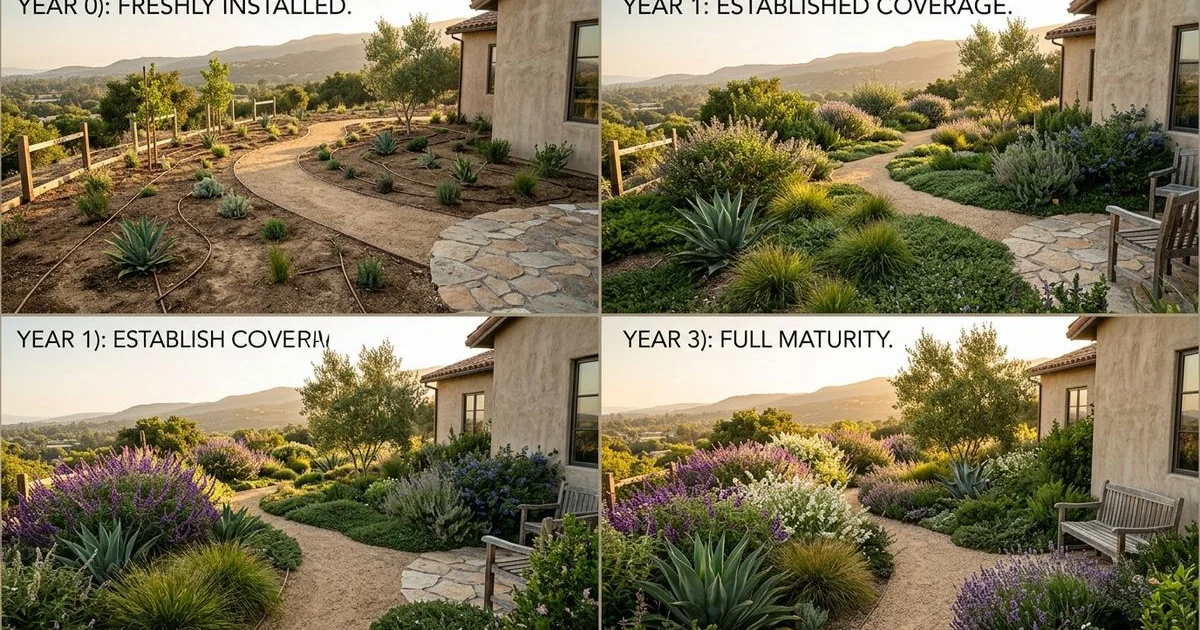
You know how a newly installed yard often looks a bit sparse on day one. Clients constantly ask how long for drought tolerant landscape to grow in, and setting the right expectation for the year-by-year fill-in pattern is the single most useful thing you can do. Those wide gaps between plants aren’t empty spaces, but necessary room for future growth.
Here at Ridgeline Outdoor Living, our mission is to provide landscaping services you can truly rely on.
We know that a proper drought design reads as deliberately young during the first twelve months, not as bare. Knowing what year one, two, and three actually look like makes the install much easier to live with. It prevents panic overwatering and helps you trust the process.
Let us look at the actual growth timeline, what the plants are doing below ground, and then explore a few practical watering strategies for each phase.
Year one: establishment
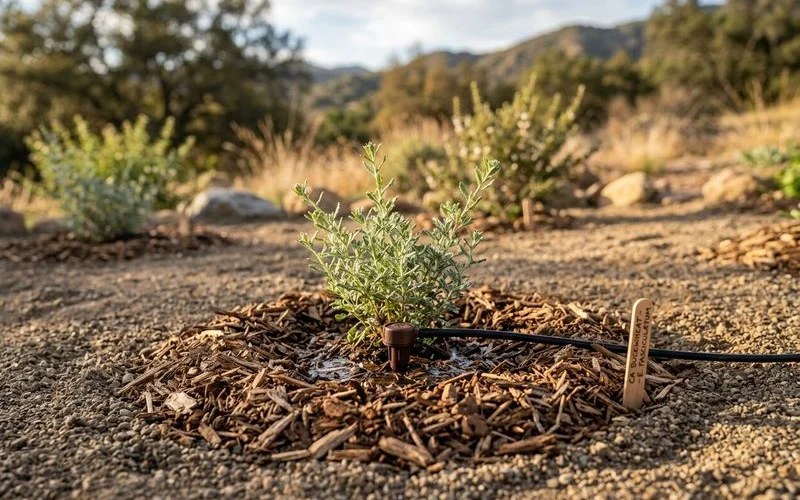
A year one drought yard is entirely about root establishment, meaning the landscape will only show about 30 to 40 percent of its eventual visual mass. Plants start small in one-gallon to five-gallon nursery pots, sitting amidst visible gaps covered by a thick layer of mulch.
Our installation team emphasizes that the drip system must run frequent, short cycles to push roots down into the soil. Native California plants facing heavy Los Angeles clay need consistent moisture during this phase to prevent transplant shock.
According to the Theodore Payne Foundation, the establishment period requires diligent monitoring. You might not see rapid top growth, but a massive root network is forming below the surface.
We highly recommend grouping plants into hydrozones based on the Water Use Classification of Landscape Species (WUCOLS) database. This strategy ensures you provide the exact amount of water needed without rotting delicate species.
Year two: visible fill
During the second growing season, your yard will finally start looking like the initial design renderings. Plants typically double or triple in size, bringing the landscape to roughly 65 to 75 percent of its intended visual mass.
We watch several specific species reach their near-mature volume during this phase:
- Ornamental grasses: Deer grass and blue oat grass establish their full texture.
- California Lilac: Popular cultivars, such as Ceanothus ‘Yankee Point’, can easily expand to three feet tall and up to eight feet wide.
- California Buckwheat: This tough shrub explodes in size and begins shedding its dried flowers, creating its own natural weed-suppressing mulch over the soil.
Our maintenance protocol shifts significantly during this second year. Drip irrigation cycles taper off to a weekly schedule during the dry months. The focus moves from frequent watering to deeper, less frequent soaking to encourage roots to dive further into the earth.
Year three: full design intent
By year three, the landscape achieves its full design intent, reading as a lush, mature ecosystem. The original plant-on-mulch composition completely disappears, replaced by a tightly knit, plant-on-plant texture.
We see larger structural shrubs like Toyon and Arctostaphylos ‘Howard McMinn’ Manzanita reaching their mature sizes of six to ten feet tall and wide. Groundcovers merge into a continuous carpet, naturally shading the soil and retaining moisture.
Drip cycles often drop to just one deep watering per month during the summer for native species. Our experience shows that Mediterranean accent zones might require a slightly more frequent schedule, but native Californian plants demand dry summers. Providing excessive summer water to an established Manzanita will actually shorten its lifespan.
Watering schedule by phase
Adjusting your irrigation based on the plant’s growth stage is critical for survival. The following schedule outlines the transition from frequent establishment watering to deep, infrequent soaking.
We advise homeowners to program their smart controllers using local California Irrigation Management Information System (CIMIS) data to adjust for monthly weather changes. A controller adjustment ensures that you do not waste water during cooler periods. The table below provides a reliable baseline for the dry months.
| Phase | Frequency (dry months) | Cycle length | Notes |
|---|---|---|---|
| Install to month 6 | 2 to 3 × per week | 30 to 45 minutes drip | Establish root system |
| Month 6 to 12 | 1 to 2 × per week | 45 to 60 minutes drip | Roots developing depth |
| Year 2 | Weekly | 60 minutes drip | Reduce frequency, increase depth |
| Year 3+ | Monthly to biweekly | 60 to 90 minutes drip | Native zones; Mediterranean run more |
For a complete breakdown of emitter types and system anatomy, see our drip irrigation guide.
Common pitfalls
Avoiding common maintenance mistakes is just as important as proper watering. The biggest risk to a young drought-tolerant landscape is well-intentioned over-care.
We constantly see the following critical errors in the field:
- Daily watering “to be safe.” Frequent shallow watering prevents deep root formation. The UC Master Gardener Program notes that this practice leaves plants vulnerable to drought and promotes fatal fungal diseases.
- Pulling mulch against plant crowns. Native above-ground tissue lacks defense against soil moisture. Keep wood chips and compost three to four inches away from the stem to prevent immediate crown rot.
- Replacing slow-growing species in year one. Shrubs like Manzanita and Ceanothus often look small forever, then explode in year two. Give them the patience they require.
- Skipping the establishment cycles. Leaving for the summer without setting a proper schedule guarantees plant death. Always set a weather-based smart controller before you travel.
Our teams replace more plants due to crown rot and overwatering than from actual dehydration. Stick to the scheduled irrigation plan even when the soil surface feels dry.
If you are still mapping out your project, our guide on california Native Plants for Los Angeles Yards covers a related angle that pairs well with this topic.
When to expect mature look: how long for drought tolerant landscape to grow in
Most Ridgeline drought designs hit that “looks finished” threshold between months 18 and 30, depending on the plant tier and sun exposure. Planning your project around that realistic drought landscape establishment time is the difference between a landscape that matures beautifully and one that gets ripped out in frustration.
We design these spaces to survive for decades, not just to look good on installation day. According to the California Department of Water Resources, a fully established native garden can reduce water consumption by up to 80 percent compared to a traditional lawn. Resisting the urge to over-water during those awkward early months will eventually yield a resilient, self-sufficient habitat.
That is the actual work behind the drought-tolerant design service: not just putting plants in the ground, but executing the watering plan and providing the replacement guarantee that gets you safely to year three. If you are ready to start planning your custom yard, review our service page to schedule a design consultation today.
Frequently Asked Questions
Will my yard look bare year one?
How much should I water in the first year?
What kills new drought plants fastest?
Have questions about a project of your own?
A free on-site consultation, a phased budget tier, and a master plan that fits your property and your goals.