Paver Driveway vs Concrete Driveway: LA Comparison
Side-by-side comparison of paver and poured-concrete driveways for LA homes — install cost, lifespan, repair, aesthetics, and crack risk.
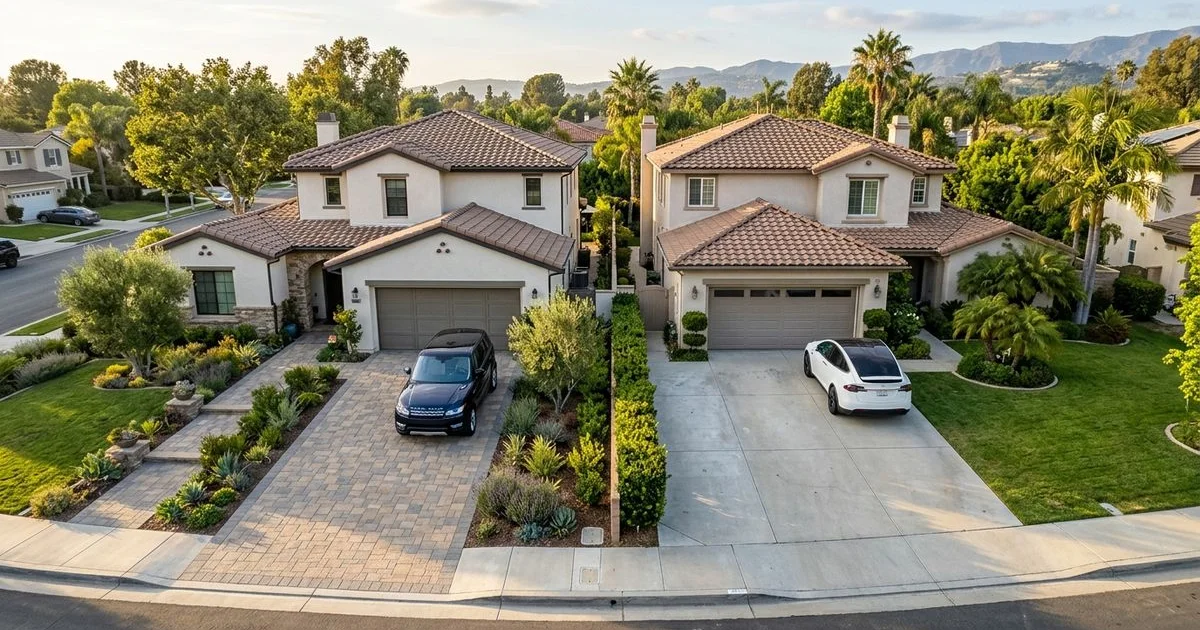
You know how quickly a heavy vehicle load exposes the weakness in a standard poured slab. This paver driveway vs concrete driveway analysis looks at the exact same forces we covered in our pavers vs concrete patio comparison, but with much higher stakes.
Our team at Ridgeline Outdoor Living was founded with a simple mission to provide exceptional landscaping and hardscaping services that customers can truly rely on. The damage from two-ton cars and shifting soil ruins basic slabs very quickly. We see these surface failures on properties every single week.
Let’s review the hard data behind material lifespans to see which option makes more financial sense for drought-conscious California homeowners.
Quick comparison
Concrete costs less upfront at $8 to $15 per square foot, while a premium paver installation ranges from $22 to $50 per square foot. Pavers last over 40 years in Southern California without cracking, making them the clear winner for long-term durability.
We built this straightforward reference matrix to highlight the functional differences between these materials.
| Dimension | Paver driveway | Poured concrete driveway |
|---|---|---|
| Install cost | $22 to $50/sq ft | $8 to $15/sq ft (plain), $18 to $30 (stamped) |
| Lifespan in LA | 25 to 40+ years | 10 to 20 years before visible cracking |
| Crack failure | Individual unit replaceable | Whole-slab problem |
| Seasonal soil movement | Flexes (joint shift) | Cracks |
| Seismic resilience | Excellent | Vulnerable |
| Repair sourcing | Easy (unit replacement) | Patches show |
| Aesthetic range | Wide (color, pattern, texture) | Plain or stamped/colored |
| Home value contribution (LA market) | Premium signal | Standard |
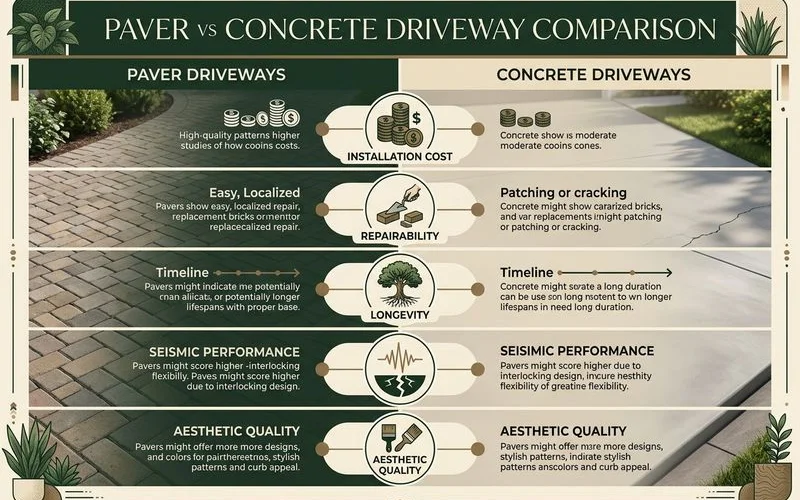
Interlocking paver stones are actually three to four times stronger than a standard poured concrete slab. This incredible density prevents the surface from cracking under the weight of heavy electric vehicles or large SUVs.
Why concrete driveways crack in LA
Concrete driveways crack in Los Angeles primarily because rigid slabs cannot flex when the underlying clay soil expands and contracts. The American Concrete Institute specifically states that zero-percent cracking in a poured slab is an unrealistic expectation.
Our installation crews regularly remove failed concrete driveways across Pasadena and San Marino. The severe damage usually stems from four specific regional factors.
- Clay-heavy soil that expands seasonally: Expansive clay soils absorb water during winter rains and shrink drastically during summer dry spells. Driveway slabs routinely crack from this severe soil heave alone.
- Seismic activity: Even minor tremors introduce hairline fractures that a rigid surface cannot absorb.
- Tree root growth: Mature tree roots easily lift and break rigid slabs in older Los Angeles streetscapes.
- Vehicle loads concentrated at tire paths: Slabs lacking proper control joints develop intense stress fractures exactly where heavy cars park.
We often inspect 12-year-old concrete driveways in Pasadena or San Marino that show severe, visible fracturing. The exact same vehicle loads on a flexible paver driveway produce essentially no functional wear.
When concrete still wins
A poured concrete driveway is the right choice when your primary constraint is a very tight initial installation budget. Plain concrete sits at $8 to $15 per square foot, making it significantly cheaper on day one than a premium paver system.
There are three specific scenarios where a basic poured slab makes practical sense.
- Very tight budget: Plain concrete is meaningfully cheaper at install for homeowners who need a functional surface immediately.
- Single-piece minimal aesthetic: Specific modern architectural designs strictly require the unbroken look of a poured concrete slab.
- Short-stay properties: A quick concrete replacement works well if you plan to sell the home before the 10-year mark when visible cracking usually begins.
Our long-term financial math heavily favors pavers for permanent California residences. The replacement cycle for concrete quickly erases any initial cost savings.
Cost ownership over 20 years
A premium paver driveway costs about $20,000 upfront and requires almost zero financial upkeep over two decades. The true pavers vs concrete driveway cost comparison becomes obvious when you factor in mandatory repairs. A standard poured slab costs less initially but forces you to spend up to $35,000 on patches and full replacements within that same 20-year window.
We break down the true lifetime cost for a standard 600-square-foot driveway in Los Angeles.
- Plain concrete: Costs $7,000 to install. You will spend $4,000 to $8,000 on crack patches over 20 years, plus a likely full replacement at year 18. This totals $25,000 to $35,000.
- Stamped concrete: Costs $14,000 to install. Expect $4,000 to $6,000 in color matching patches, followed by a replacement around year 16. This totals $30,000 to $40,000.
- Premium pavers: Costs $20,000 to install. The surface requires minimal maintenance and remains fully functional at year 20. This totals $20,000.
- Pavers with year-15 minor reset: Costs $20,000 to install plus a $1,000 minor edge reset later on. This totals $21,000.
Our environmentally conscious clients often reduce this initial paver cost through local utility incentives. The Los Angeles Department of Water and Power offers a Turf Replacement Rebate paying $5 per square foot.
You can claim this money by replacing a thirsty lawn with drought-tolerant landscaping and permeable pavers. This rebate turns a premium upgrade into a highly subsidized home improvement.
Stamped concrete
A stamped concrete driveway looks appealing on day one but suffers from the exact same cracking failures as a plain poured slab. This decorative option costs $18 to $30 per square foot, yet the stamped patterns quickly fade under the intense California sun.
We see this material rapidly losing ground in the Los Angeles market. Homeowners originally loved stamped concrete in the 1990s and 2000s because it mimicked natural stone or brick.
Industry Warning: Any structural repairs to a stamped surface require patching with new material, and these patches will never perfectly match the original faded color.
The aesthetic now reads as highly dated to modern buyers. This material leaves property owners stuck with obvious, mismatched scars across their driveway after a single crack repair.
Our current paving projects in Los Angeles almost exclusively use premium interlocking stones or plain modern concrete. The stamped concrete vs paver driveway debate usually ends quickly once buyers realize stamped concrete sits in an awkward middle ground that offers no actual structural benefits.
Pavers and curb appeal
Paver driveways provide a massive boost to your home value because they signal high-quality architectural design to potential buyers. Plain concrete reads as a cheap, development-grade default in high-end Los Angeles neighborhoods.
We consistently install premium pavers in Beverly Hills, San Marino, and the most desirable Pasadena streets. Buyers in these areas simply expect this upgraded aesthetic on a luxury property.
A well-designed paver surface also provides critical environmental benefits for drought-conscious residents:
- Groundwater Recharge: Permeable paving stones allow rainwater to filter directly through the joints into the earth.
- Runoff Reduction: These surfaces prevent heavy winter rains from overwhelming local city storm drains.
- Rebate Eligibility: Installing eco-friendly hardscaping helps you qualify for local water conservation incentives.
Our designs actively help homeowners meet strict California Low Impact Development regulations regarding stormwater management. This eco-friendly function combined with a stunning visual presence makes pavers an unbeatable choice for lasting curb appeal.
If you are still mapping out your project, our guide on how Long Do Paver Driveways Last? covers a related angle that pairs well with this topic.
What we typically recommend
Premium paver driveways are the absolute right call for the vast majority of permanent residences in Los Angeles. This material delivers unmatched crack resistance, an impressive 40-year lifespan, and a massive boost to your daily curb appeal.
We do recognize a few specific exceptions where concrete makes sense.
- Very budget-tight projects: Plain concrete is a better option than leaving a completely destroyed driveway in place.
- Short-term holds: Maximizing pre-sale curb appeal is not always worth the premium installation cost if you plan to move next year.
- Modern minimal aesthetics: A poured concrete slab perfectly matches specific ultra-modern architectural designs.
Long-term value and structural integrity dictate our approach for every property. Interlocking stones simply outlast and outperform rigid slabs in our active California climate.
We apply this dedication to lasting quality behind Ridgeline’s paver driveway service. You can explore the exact same durability principles across our broader paver patio and hardscape work.
Contact our design team today to schedule a site visit and protect your property with a surface built to last.
Frequently Asked Questions
Is a concrete driveway cheaper than pavers?
Why do concrete driveways crack?
Which adds more home value?
Have questions about a project of your own?
A free on-site consultation, a phased budget tier, and a master plan that fits your property and your goals.