Paver Driveway Base Preparation: Why Driveways Need More Than Patios
Why paver driveways need a deeper, more compacted sub-base than patios — excavation depth, aggregate spec, and edge restraints for vehicle loads.
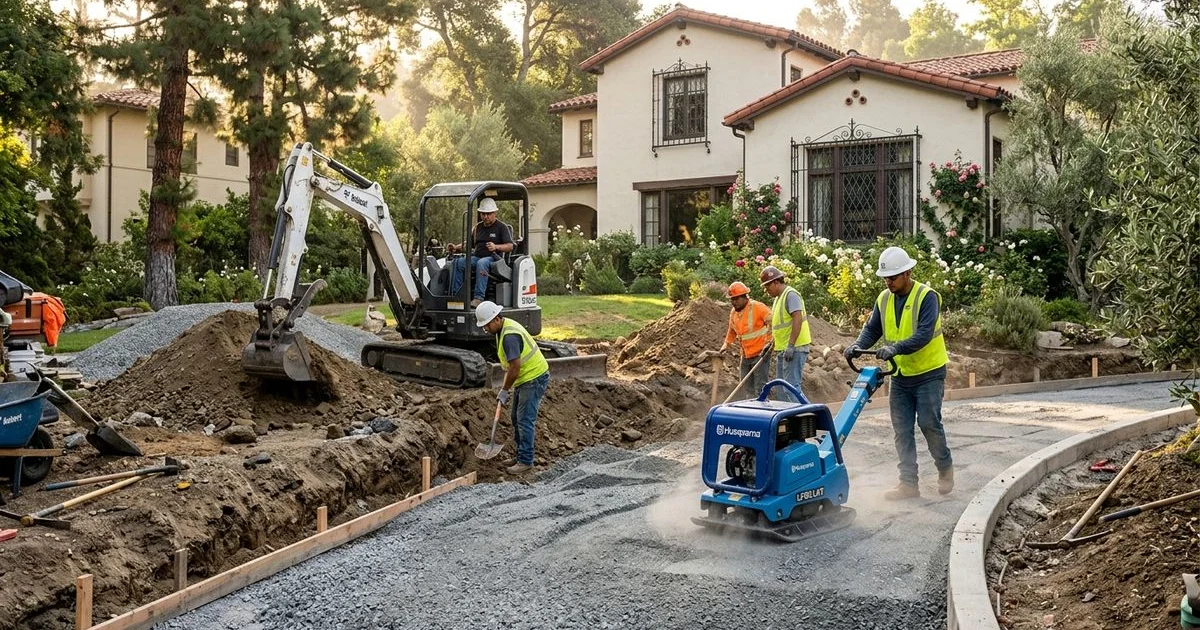
We often see homeowners make a critical mistake when planning hardscapes. A common assumption is that a patio base will work for a driveway. Proper paver driveway base preparation, however, requires a fundamentally different foundation to support a vehicle’s massive weight.
At Ridgeline Outdoor Living, our company was founded with a simple mission: to provide exceptional landscaping and hardscaping services that customers can truly rely on. This standard means engineering bases that handle immense weight while supporting California water conservation goals.
It separates a 25-year investment from a surface that sinks in months.
Our team approaches paver driveway base preparation with strict compaction disciplines and precise aggregate specifications. Let’s look at the data, what it actually tells us, and explore the exact steps to build a surface that lasts decades.
What separates driveway base from patio base
Three core factors dictate the difference between these two surfaces.
- Depth: Standard driveway base depth requires 6 to 10 inches of compacted aggregate, whereas patios only need 4 to 6 inches. For drought-conscious properties using permeable pavers, that depth increases to 8 to 12 inches to create an adequate stormwater reservoir.
- Aggregate specification: Driveways demand Class II road base or clean, open-graded crushed stone like ASTM No. 57 for permeable systems. Patios can often get by with softer materials like decomposed granite.
- Compaction discipline: Driveways require high-density compaction using a machine that generates at least 3,000 to 5,000 pounds of centrifugal force (lbf). You must run the compactor between every 1 to 2 inch lift.
Our crews never skip these steps because the consequences are immediate. Missing any of these benchmarks guarantees a failed surface with wheel ruts and edge spreading within 12 to 36 months.
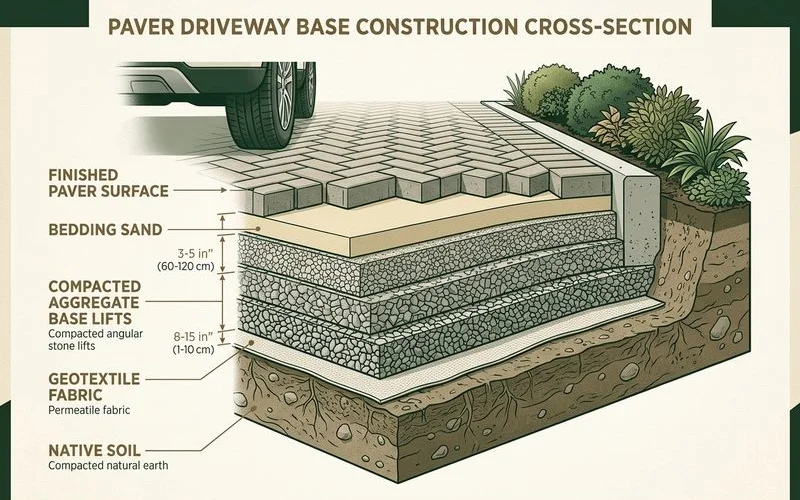
A correct paver driveway base preparation, top to bottom
Visualizing the system from the finished surface down makes the engineering easier to understand. The layers must work together to distribute weight and manage water runoff.
The surface and bedding layers
The top sections handle direct vehicle contact and provide the final aesthetic finish.
- Layer 1: Pavers. You need vehicle-rated paver units, such as the Belgard or Angelus driveway lines. These are manufactured to withstand heavy friction.
- Layer 2: Bedding material. Standard systems use 1 inch of clean, screeded sand. Permeable, drought-friendly systems replace this sand with a 1.5-inch layer of ASTM No. 8 crushed stone to allow rapid water infiltration.
- Layer 3: Upper geotextile or jointing layer. Heavy-duty installations sometimes specify an upper layer to lock the bedding material in place.
The structural foundation
The hidden layers below ground do all the heavy lifting and protect the soil from shifting.
- Layer 4: Compacted paver driveway sub base. This is a 6 to 10 inch layer of aggregate, installed in 2-inch lifts with heavy compaction between each pass.
- Layer 5: Geotextile fabric. This critical barrier separates the aggregate from the native soil. Standard driveways utilize a woven geotextile because its high tensile strength prevents rutting. Permeable driveways require a non-woven geotextile to prioritize fast water drainage into the ground.
- Layer 6: Native soil. The original dirt must be excavated and compacted to a firm subgrade before any materials are added.
Our experience shows that compaction is the true differentiator between a driveway that lasts 25 years and one that fails in five. A 300-pound plate compactor or a roller must pass over every single lift before the next layer of aggregate goes down. This rigorous process guarantees maximum density and stability.
Edge restraints
Vehicle weight pushes outward at the perimeter every time a car turns its wheels. Driveway pavers require significantly more aggressive edge restraints than a standard backyard patio.
Heavy-duty plastic, aluminum, or paver soldier-course restraints are the industry standard. Contractors often pin these borders down with 10-inch rebar stakes driven directly into the compacted sub-base. A concrete bond beam hidden just below the soil line offers another highly effective, permanent solution for securing the perimeter.
We consider missing edge restraints to be the second most common cheap-install corner cut, right behind poor compaction discipline. Skipping this vital step causes the outer driveway pavers to spread apart within months of regular use. A strong border eliminates this lateral movement entirely.
Heavy-load adjustments
Different vehicles apply wildly different stress levels to a hardscape. The base must be adjusted to match the heaviest item that will park on the property.
Common residential weight categories
- RVs or boat trailers: Add 2 to 3 inches to the base depth. You must upgrade to the heaviest aggregate specification to prevent deep tire ruts over time.
- Crew-cab trucks: Heavy vehicles like an F-350 require the same upgraded depth. Vehicle curb weight directly dictates the foundation requirements.
- Frequent service vehicles: If delivery trucks or garbage trucks cross the apron, you need the heaviest commercial specification available.
- Multiple standard cars: A driveway storing two or three standard commuter sedans will do perfectly fine with the standard residential specification.
Our project managers always ask about specific vehicle use during the initial site visit. A transparent conversation about exactly what you plan to park there ensures the base is engineered correctly from day one.
Vehicle-rated paver selection
Standard patio pavers and driveway pavers look identical on a pallet, but they are not always interchangeable. Placing a pedestrian paver on a driveway is a fast track to cracked stones.
Key features of driveway-rated units
Driveway-rated pavers possess three specific characteristics that help them survive heavy use.
- Thickness: Vehicular pavers have a minimum thickness of 60mm (about 2.36 inches), while standard patio pavers are often only 50mm. Some heavy-duty commercial stones go up to 80mm.
- Compressive strength: They feature a higher PSI rating to resist the direct crushing force of a vehicle tire.
- Aspect ratio: Vehicular pavers generally have a smaller surface area relative to their thickness. This stout shape prevents the stone from snapping under pressure.
Most driveway lines from top manufacturers, such as Belgard’s Cambridge or Mega-Bergerac series, are specifically engineered for residential vehicle use. You must always confirm the manufacturer’s specification for vehicle use rather than assuming a thick stone will hold up.
Driveway widening considerations
When widening an existing driveway, the new section’s base must match or exceed the existing driveway’s depth. Mismatched bases create weak joints where the surface will eventually settle unevenly.
We approach widening projects by scoping a consistent base depth across both the new and existing sections. Field crews frequently pull up the outer edges of the existing driveway to physically verify the old base depth before digging the new trench.
Proper drainage integration is another vital component of widening. Expanding your hardscape footprint increases the amount of impermeable surface on your property. Drought-conscious homeowners should consider using permeable pavers for the newly widened section to capture rainwater and redirect it into the local water table, which actively supports California’s water conservation efforts.
If you are still mapping out your project, our guide on how Long Do Paver Driveways Last? covers a related angle that pairs well with this topic.
Permits and curb cuts
Driveway widening that extends to the city right-of-way requires a specific curb-cut permit from the local Bureau of Engineering. Municipalities like Pasadena B&S, LADBS, and other Los Angeles-area cities each handle this approval slightly differently.
Common Los Angeles permit requirements
The application process usually involves verifying several local codes.
- Approved curb-cut data sheets: Verifies the new approach width meets the minimum city code.
- Utility clearances: Ensures water meter boxes and gas shut-off valves are not obstructed by the new driveway.
- Shared driveway affidavits: Required by LADBS if the access point crosses property lines.
You should anticipate a paperwork lead time of 4 to 8 weeks for a standard Class A permit.
We file these applications early and intentionally stack the installation schedule behind the approval date. This proactive approach prevents costly delays once the heavy equipment arrives on site.
For more details on project scheduling, you can review our paver patio installation timeline, which is similar but lighter than driveway work. If you want to see the specific paver driveway base preparation that delivers a 25-year lifespan, explore Ridgeline’s paver driveway service today.
Frequently Asked Questions
How deep should a paver driveway sub-base be?
What aggregate is best for a paver driveway sub-base?
Why does base prep matter so much for driveways?
Have questions about a project of your own?
A free on-site consultation, a phased budget tier, and a master plan that fits your property and your goals.