How Long Do Paver Driveways Last? (LA Lifespan Guide)
Realistic paver driveway lifespan in LA — what shortens it, what extends it, and how proper base prep separates a 25-year driveway from a 5-year one.
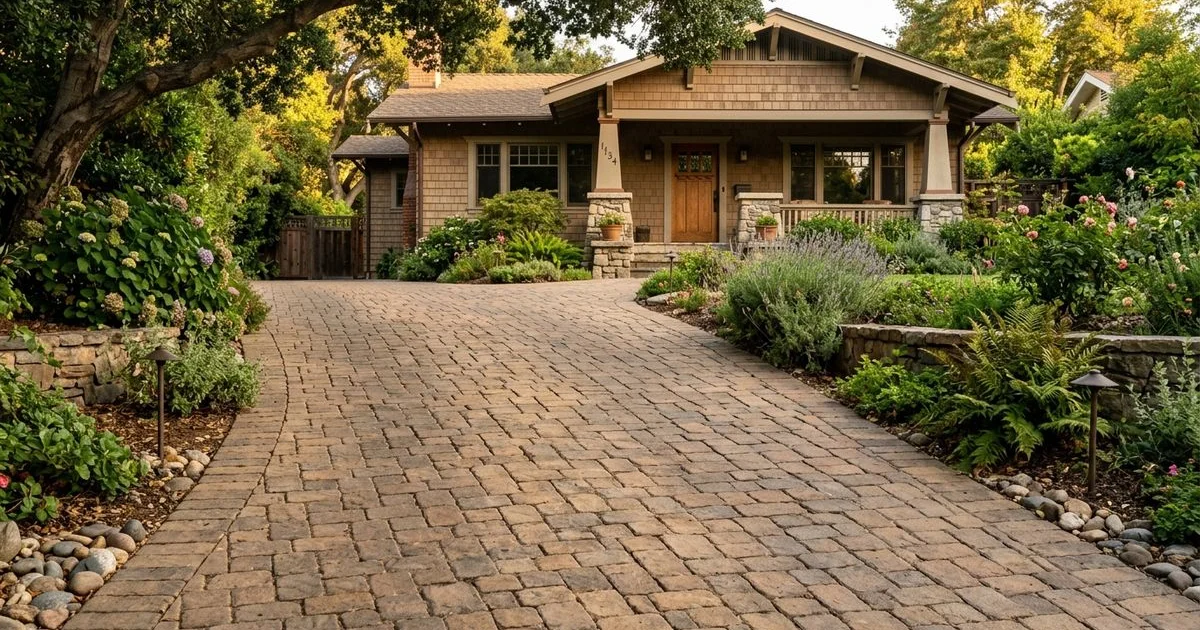
We founded Ridgeline Outdoor Living with a simple mission: to provide exceptional landscaping and hardscaping services that customers can truly rely on. This focus on long-term reliability naturally leads to the question of how long do paver driveways last.
Our experience shows that a properly built surface in LA conditions easily lasts 25 to 40 years with minimal maintenance. You might see a cheaply built one fail in just five years.
The variable isn’t the stone itself, but rather everything installed underneath it.
Let’s look at the data driving these lifespans and explore exactly how to assess your current setup.
Realistic lifespan ranges
| Install quality | Typical lifespan in LA |
|---|---|
| Premium install (full ICPI standards, proper base, edge restraints, polymeric sand) | 25 to 40+ years |
| Mid-tier install (most major points addressed) | 15 to 25 years |
| Budget install (some corners cut) | 8 to 15 years |
| Cheapest install (minimal base, no edge restraints) | 3 to 7 years |
Driveways are not a category where premium and budget converge. The gap is enormous because cheap installation failures are progressive and visible.
Concrete slabs usually crack and require replacement within 15 to 20 years. Paver systems are designed to handle up to 8,000 PSI, which makes them nearly twice as strong as standard concrete.
Our installation crews see this massive performance difference firsthand. These durable surfaces prove why proper building techniques are a smarter long-term investment.
What shortens lifespan
- Insufficient base depth: This is the single biggest factor in driveway durability. The Interlocking Concrete Pavement Institute requires a minimum 6 to 8 inches of compacted Class II aggregate base for residential driveways in California. We often find cumulative settling under wheel paths within a few years if the depth is under 6 inches or built over soft clay soils.
- Missing edge restraints: The hidden aggregate base must extend at least 6 inches beyond the final edge restraint. This crucial step prevents the aluminum or concrete edging from sinking into soft ground. Our repair teams notice that edge pavers spread outward and joints open when this extended base is skipped. The entire system then loses structural integrity.
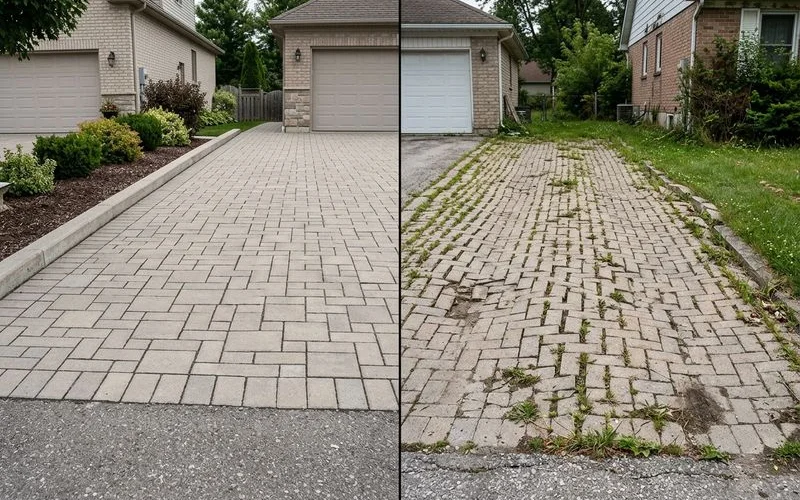
- Polymeric sand washed out (or never installed): Washed-out sand leaves joints completely vulnerable. Weeds take over the open gaps, and the individual units start grinding against each other. We highly recommend topping up this material before those weeds take root.
- Inadequate compaction: You will notice wheel ruts appearing exactly where you park if the base material wasn’t compacted in multiple lifts. Even a deep base fails without proper compaction layers.
- Heavy vehicle use beyond design spec: Heavy vehicles will crush a standard residential base. RVs, boats, or frequent heavy truck deliveries quickly destroy a driveway sized only for sedans. Our assessment process always factors in the specific weight loads your property will handle.
- Tree root growth under the base: Roots heave or sink the surface unevenly. You must install root barriers or redesign the layout to accommodate mature trees.
What extends lifespan
- Annual cleaning: Sweep or pressure-rinse the surface once or twice a year to keep organic debris out of the joints. This simple habit is your best defense against early wear.
- Polymeric sand top-up at year 5 to 10: Restore joint sand if washout shows. We recommend using high-performance brands like Alliance Gator Maxx G2 or Dominator XL for touch-ups. These modern sands require joint widths of at least 1/8 inch and a 1-inch depth to cure properly.
- Drought-conscious upgrades: Homeowners prioritizing water conservation should absolutely consider permeable paver systems. Our favorite specialized installations, like the Belgard permeable lines, allow rainwater to filter naturally into the ground. Permeable setups reduce stormwater runoff by 50 to 90 percent, which helps replenish local California groundwater and satisfies strict environmental regulations.
- Address damage immediately: A single cracked stone is a localized problem that takes minutes to fix. We always warn clients that surrounding units will quickly shift and sink if you leave a broken piece unaddressed.
- Don’t pressure-wash too aggressively: High-pressure tips easily blast the specialized sand right out of the joints. A moderate pressure setting cleans the stones without damaging the vital bonding agents.
- Wait before driving on a wet base: Do not drive on the surface immediately after installation. Give the polymeric sand time to harden into a flexible, protective seal.
Pattern of decline (premium install)
| Years | What you will see |
|---|---|
| 0 to 5 | Indistinguishable from new |
| 5 to 10 | Minor settling at heavy-traffic spots, rare; polymeric sand top-up may be due |
| 10 to 20 | Slight color softening (premium pavers), no functional issues |
| 20 to 30 | Pattern still holding, occasional individual paver replacement |
| 30+ | Most installs still functional; eventual full replacement when surface is tired |
A premium paver driveway in Pasadena, San Marino, or Beverly Hills installed today should reliably outlast the homeowners’ tenure.
Our teams routinely see properly installed surfaces look virtually indistinguishable from new for the first five years. The color may soften slightly by year 15, but the structural integrity remains rock solid.
How to assess an existing paver driveway
Walk the surface carefully and look for specific warning signs. Our inspectors use this exact checklist during property visits:
- Visible wheel ruts at the tire path point to a clear base failure.
- Stones that click or shift underfoot indicate base issues or severe sand washout.
- Edge pavers visibly spreading outward mean your edge restraints have failed.
- Wide gaps showing missing material require immediate polymeric sand replenishment.
- Sunken or heaved sections near mature landscaping point to a tree root invasion.
- Cracked individual units might be localized damage or a symptom of broader foundational sinking.
A driveway showing one of these in year five isn’t necessarily a teardown. We often find that early intervention can extend your paver driveway lifespan considerably.
Repair vs replace
Localized issues like a few broken units or edge spreading on one side can usually be repaired quickly. Widespread problems such as deep wheel ruts across the full width usually require a complete base rebuild. You are essentially redoing the installation at that point.
Our goal is to help you avoid that costly scenario by doing the job right the first time. For more on getting the base right initially, see paver driveway base preparation.
For installation discipline that delivers the 30-year version, see Ridgeline’s paver driveway service. Long-term paver driveway durability comes down to choosing the right contractor and committing to a few simple maintenance habits over the years.
Frequently Asked Questions
What's the typical lifespan of a paver driveway in LA?
When does a paver driveway need maintenance?
What if a few pavers crack or stain?
Have questions about a project of your own?
A free on-site consultation, a phased budget tier, and a master plan that fits your property and your goals.