French Drains, Dry Wells, and Channel Drains: Which Do You Need?
What each drainage system does and when to use it. French drains for soil saturation, dry wells for collection, channel drains for hardscape runoff.
We see homeowners struggle with runoff management constantly.
Choosing the right yard drainage system types from the start saves both water and money. Knowing the categories makes the consultation process much more productive.
It also helps you spot a contractor pushing the wrong solution. Our team designed this guide to explain the main options clearly.
You will learn how to keep water on your property effectively.
French drain: for soil saturation and groundwater
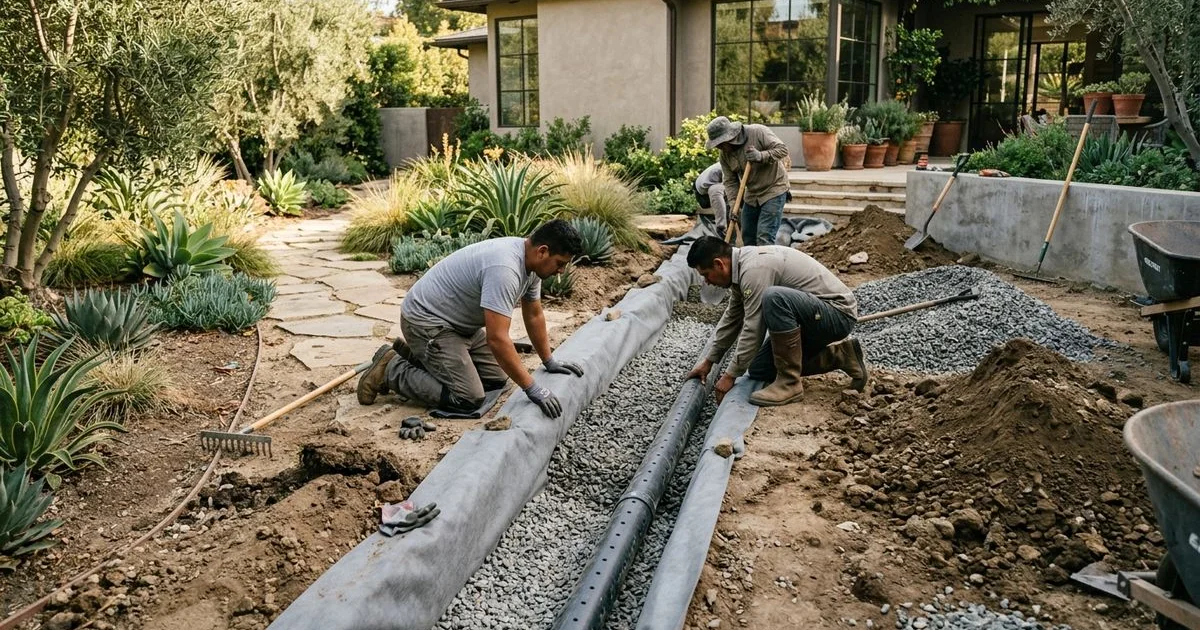
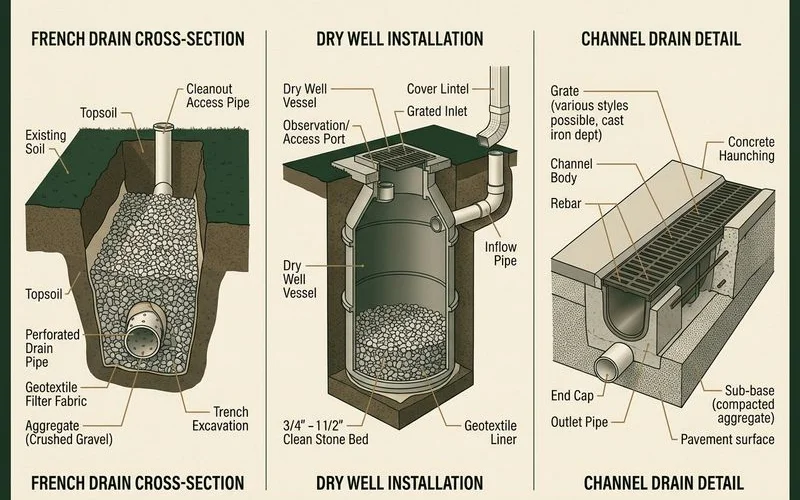
A French drain is a perforated pipe wrapped in geotextile fabric, buried in a graded gravel envelope, and designed to collect saturated groundwater. This system actively moves excess moisture away from foundations to a safe discharge point. The EPA notes that improper foundation drainage causes a significant portion of residential water damage.
- What it solves: Soggy lawn areas, slow-draining flat yards, water accumulating against a wall, hillside seepage, and sub-foundation moisture.
How it is built:
We cut a trench to grade, usually 18 to 36 inches deep. Geotextile fabric lines the trench to block silt. A gravel envelope surrounds a 4-inch perforated pipe. The fabric folds over the top before adding soil backfill.
Our installation crews always verify the required 1 to 2 percent pipe slope with laser levels. Proper grading ensures water actually reaches the curb or dry well.
Cost relativity:
Pricing runs per linear foot installed. You can expect ranges from $50 to $150 per linear foot in the 2026 California market. Costs shift based on depth, heavy clay soil conditions, and machine access.
Dry well: for collection and absorption
A dry well is an underground void designed to receive water from drains and hold it temporarily. The water then absorbs slowly into the surrounding soil over a period of hours or days. We frequently install these to help recharge local groundwater aquifers. This function makes them a perfect fit for drought-conscious California homeowners.
- What it solves: Downspout discharge with nowhere to go, terminating French drain runs that cannot reach a curb, properties without legal discharge to the street, and lots restricted by 2026 local Low Impact Development regulations requiring on-site water retention.
How it is built:
Excavation typically hits a depth of 4 to 8 feet. Installers set a structural chamber, like those manufactured by NDS or Cultec. Inlet pipes connect directly to the chamber. Fabric wraps the entire unit to prevent fine dirt from clogging the gravel base, and then soil covers the top.
Sized for:
Proper sizing requires multiplying the soil infiltration rate by the volume of water expected during a target storm event. Undersized dry wells remain a common, frustrating failure point. Our design team strictly follows local stormwater guidelines to prevent overflow. Using exact calculations prevents expensive property flooding.
Cost relativity:
Contractors price these per chamber or per cubic yard of gravel. Installation typically runs $1,800 to $5,500 depending on the required capacity.
Channel drain: for hardscape runoff
A channel drain is a long, surface-mounted trench set directly into hardscape areas like patios or driveways. It catches sheet runoff right at the surface before water has a chance to pond. We recommend these for any large paved area lacking natural slope. Fast removal prevents water damage to nearby structures.
- What it solves: Driveway runoff sheeting straight toward a garage door, patios that mistakenly slope toward the house foundation, pool deck water concentration, and any hardscape area requiring immediate surface drainage instead of slow soil absorption.
How it is built:
Workers set a cast or pre-fab plastic channel flush with the surrounding concrete or pavers. A durable grate sits securely on top. An outlet pipe then routes the captured water to a French drain, dry well, or street discharge. NDS Spee-D channel systems serve as a standard choice for residential driveways due to their high flow capacity.
Cost relativity:
Installation runs per linear foot. Expect $90 to $280 per foot installed, which covers the concrete cutting and pipe connection.
Which do you need?
Choosing between a channel drain vs french drain or a french drain vs dry well depends entirely on the source of the water.
| Problem | Best fit |
|---|---|
| Soggy lawn areas | French drain |
| Slow-draining flat yards | French drain feeding dry well |
| Water against foundation | Surface re-grading + French drain |
| Downspout dumping concentrated water | Dry well or French drain |
| Hillside groundwater | French drain at slope toe |
| Driveway sheeting toward garage | Channel drain at garage edge |
| Pool deck pooling | Channel drain at low edge |
| Patio sloping toward house | Channel drain + re-grading |
Most local drainage projects require combining two or three of these methods. A common setup pairs French drains feeding a dry well with channel drains positioned at key hardscape transitions.
Our landscape architects use this blended approach to manage heavy winter rain while keeping water on the property. This strategy protects your foundation and supports the local water table.
If you are still mapping out your project, our guide on causes of Yard Flooding and Standing Water in LA Homes covers a related angle that pairs well with this topic.
Where these fit in a project
For most properties, drainage gets built alongside any hardscape work or retaining wall installation. Trenching everything in one single event minimizes yard disruption. Standalone drainage retrofits are also a regular Ridgeline scope when the existing yard floods without other planned changes.
That is the dedicated yard drainage service at work. We ensure every system protects your home while supporting a sustainable, water-smart landscape. Reach out to schedule a consultation if you are tired of dealing with standing water.
Frequently Asked Questions
Which is best for a flat, soggy yard?
Do I need a permit for a dry well?
How often do drains need cleaning?
Have questions about a project of your own?
A free on-site consultation, a phased budget tier, and a master plan that fits your property and your goals.