Low-Voltage Landscape Lighting: Zones and Design Basics
How professional landscape lighting is designed: path, accent, up- and down-lighting, zone planning, fixture selection, and smart controllers.
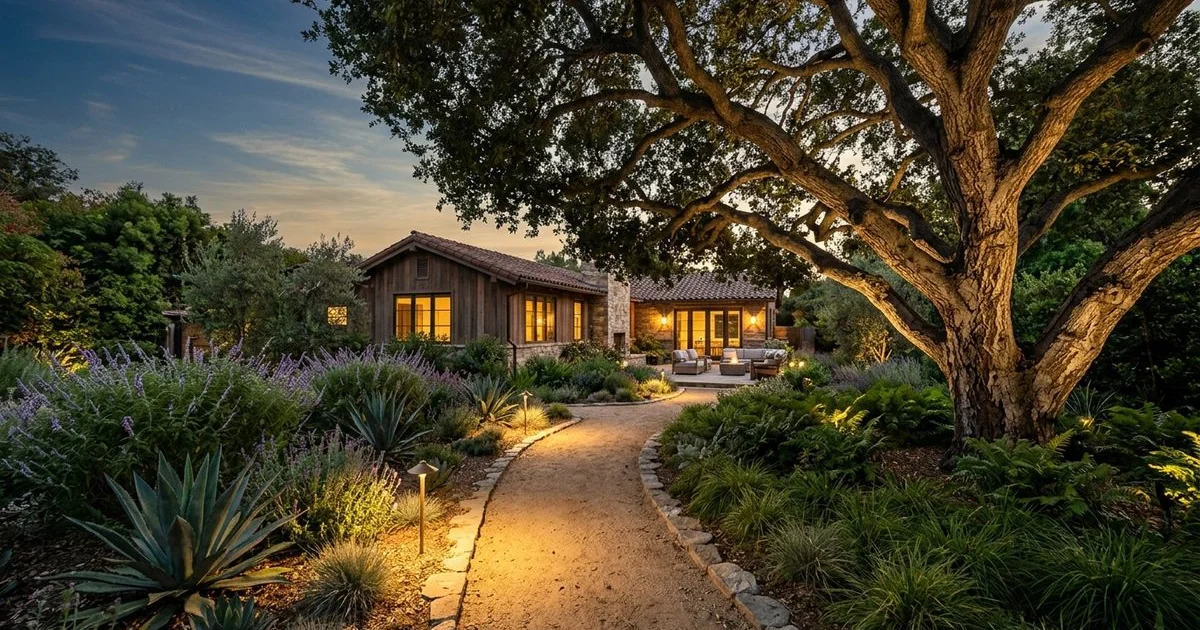
Our team at Ridgeline Outdoor Living was founded with a simple mission: to provide exceptional landscaping and hardscaping services that customers can truly rely on. This commitment extends into how properties function after dark.
Properly executed landscape lighting design is the dividing line between a yard you abandon at sunset and an outdoor living space that gets twice the daily use. Smart low voltage outdoor lighting is the most cost-effective aesthetic upgrade you can layer onto a finished property.
Let’s look at the data, what it actually tells us about modern fixture capabilities, and outline the exact design logic professionals use to illuminate a site.
Lighting categories (and what they each do)
Landscape lighting categories define the specific beam angles, mounting heights, and purposes of individual fixtures within a cohesive design. A successful installation layers four to six of these specific lighting types so the eye reads dimension and depth rather than flat brightness.
We utilize highly efficient LED technology across all these categories. A modern 5-watt LED fixture easily replaces an outdated 35-watt halogen bulb, delivering an 80% reduction in energy usage while lasting up to 50,000 hours. This efficiency makes comprehensive outdoor lighting entirely practical for drought-conscious California homeowners looking to minimize utility footprints.
- Path lighting: Low fixtures spaced 6 to 10 feet apart along walkways, positioned from ankle to knee height. Their job is wayfinding and safety, not broad feature illumination.
- Up-lighting: Ground-level fixtures pointing upward into tree canopies, retaining walls, or architectural columns. This creates the most dramatic single visual effect in any outdoor setup.
- Down-lighting / moonlighting: High-mounted fixtures secured in mature trees or under architectural eaves pointing downward. The effect mimics natural moonlight and provides soft ambient coverage over a wide area.
- Accent lighting: Tightly focused beams aimed at specific focal points. A well-placed accent light highlights a water fountain, a stone sculpture, or a prized specimen plant.
- Step lighting: Recessed or surface-mounted units built directly into stair risers. Downward-facing step lights prevent dangerous trips and falls on uneven elevation changes.
- Wall wash: Wide-angle fixtures that cast even, diffuse illumination across a broad vertical surface. These are ideal for showcasing the texture of a stucco facade or a natural stone retaining wall.
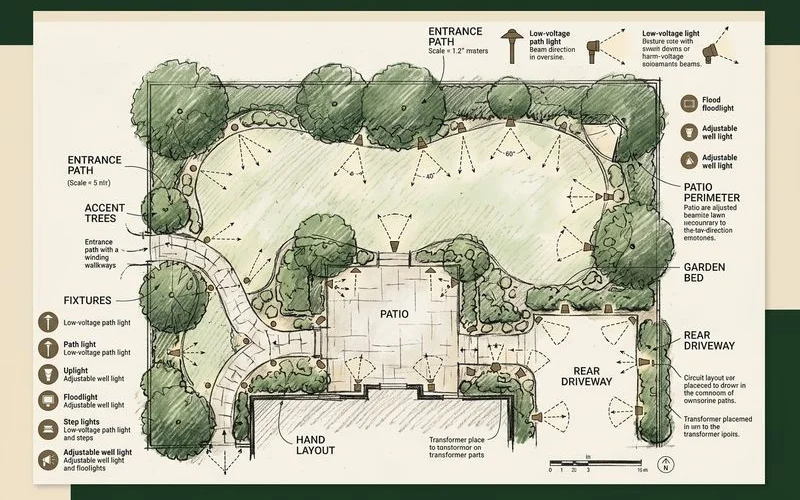
Zone planning principles
Landscape lighting zones are independent electrical circuits that allow you to group specific fixtures and control them on their own automated schedules. Organizing your property into distinct functional areas prevents over-illumination and significantly reduces wasted electricity.
Our standard residential design typically splits a property into several distinct circuits. This separation gives you complete control over which areas stay lit for safety and which turn off early to save power.
- Path and driveway zone: Activated at sunset for safe navigation, scheduled to turn off late in the evening.
- Architectural and facade zone: Illuminates the home exterior at sunset, usually scheduled to turn off by midnight to meet local municipal codes.
- Feature and accent zone: Highlights garden focal points starting at dusk, turning off late.
- Patio and entertainment zone: Manually activated during outdoor use, turned off when the gathering ends.
- Security and motion zone: Kept on a low dim or triggered instantly by movement around property perimeters.
Recent 2026 updates to smart controllers from brands like Hunter Hydrawise and FX Luminaire offer advanced scheduling capabilities. These systems include astronomical timeclocks that automatically adjust your on/off times based on the precise sunset and sunrise data for your zip code.
Compliance Rules for Landscape Lighting Zones
Many California municipalities now enforce strict energy and light pollution codes. The Title 24 regulations and local nuisance laws often mandate the 11:00 PM Rule, requiring decorative and non-security zones to heavily dim or extinguish completely by 11:00 PM. Designing your system with multiple independent zones makes compliance automatic and effortless.
Fixture selection
Selecting the right physical hardware dictates whether your system lasts two decades or fails within a few seasons. Material quality matters far more than the marketing claims printed on the spec sheet.
We frequently specify FX Luminaire and VOLT® Lighting fixtures on our projects because of their heavy-duty engineering and deep product libraries. Choosing fixtures with replaceable LED modules is a critical insider tip. Integrated LED units force you to throw away the entire metal housing if a single internal diode burns out.
To make an informed decision, compare the standard materials side-by-side:
| Material Type | Average Lifespan | Best Application |
|---|---|---|
| Solid Brass | 20+ years | Premium choice; develops a beautiful natural patina and withstands harsh coastal salt air. |
| Cast Aluminum | 5-10 years | Budget tier; the powder coating eventually chips, leading to oxidation and pitting. |
| Composite / Plastic | 1-3 years | Avoid for permanent installations; degrades quickly under intense UV sun exposure. |
Beam spread and lumens
Beam spread defines the width of the light cone, while lumen output measures the actual brightness intensity of the fixture. Matching these two variables accurately to the physical target is the core technical skill of professional illumination.
A massive 60-foot oak tree requires a narrow-beam, high-lumen up-light to push the illumination all the way into the upper canopy. A small 4-foot stone bench needs a wide-beam, low-lumen wash to avoid creating harsh, blinding hot spots.
The generic 1000-lumen floodlight sold at big-box hardware stores is a classic cheap-installation trap. Using overpowering fixtures everywhere washes out the subtle textures of your landscaping and wastes electricity. Professional installations match specific lumen counts to distinct applications:
- Small Garden Beds: 100 to 300 lumens for soft, low-level wash lighting.
- Pathways and Walkways: 300 to 400 lumens to ensure safe foot traffic without blinding guests.
- Towering Architectural Columns: 800 to 1000+ lumens for tight, focused vertical beams.
Smart-control basics
Modern low voltage transformers feature built-in Wi-Fi and Bluetooth connectivity for total system management via smartphone apps. This technology allows you to monitor and adjust your entire property from anywhere with an internet connection.
Our technicians install digital control modules that eliminate the need for outdated mechanical dial timers. From a smartphone dashboard, you can perform several advanced functions:
- Set precise sunset and sunrise schedules for each independent zone.
- Group different fixtures into custom scenes (like an entertainment scene, a late-night security scene, or a soft ambient scene).
- Dim individual zones independently to dial in the perfect brightness.
- Trigger complex lighting schedules using voice commands through popular smart home assistants.
Light pollution and dark-sky considerations
Environmentally responsible lighting protects the natural night sky and prevents aggressive glare from spilling into neighboring properties. Modern landscape aesthetics favor a less is more approach, focusing on placing light only where it serves a distinct functional or architectural purpose.
DarkSky International set clear certification standards for 2025 and 2026, establishing strict rules for responsible illumination. Local California ordinances heavily lean on these principles to dictate what homeowners can install.
Core Dark-Sky Principles for Landscape Lighting Design
A compliant, neighbor-friendly design must adhere to specific technical requirements to reduce unnecessary sky glow and protect nocturnal wildlife.
- Fully Shielded Fixtures: The fixture housing must enforce 0% uplight above the horizontal plane. All illumination must be directed strictly downward toward the ground or the intended target.
- Warm Color Temperatures: Blue light scatters heavily in the atmosphere and disrupts migratory birds. Regulations mandate using warm white Color Correlated Temperatures (CCT) of 2700K to 3000K.
- Lumen Caps: Many residential zones limit the total output of decorative fixtures, ensuring the light remains soft rather than glaring.
Unshielded floodlights and harsh 4000K blue-white LEDs are frequent code violations in many California cities. Protecting the night sky improves your local environment and creates a much more relaxing, resort-like atmosphere in your own backyard.
Where to start
A physical walk-through of your property at dusk is the fastest, most accurate way to plan a comprehensive lighting upgrade. Seeing how the shadows fall and identifying the natural focal points provides clarity that a daytime blueprint simply cannot match.
What to expect during an evening consultation:
- Live Fixture Demos: We temporarily place battery-powered lights to show exact beam spreads in your yard.
- Color Temperature Tests: You can view the difference between 2700K and 3000K against your home’s exterior walls.
- Dark-Sky Assessment: We identify potential glare issues and plan for proper fixture shielding.
If you are still mapping out your project, our guide on drip Irrigation Systems for California Yards covers a related angle that pairs well with this topic.
We always bring sample fixtures to these evening consultations. This hands-on demonstration shows you exactly how different beam spreads and color temperatures read on your specific trees and retaining walls. That conversation is the start of the lighting and irrigation service: design first, install second.
By evaluating the site under real conditions, you avoid costly guesswork and guarantee that every fixture serves a distinct purpose. Reach out today to schedule your evening walk-through and eliminate the guesswork from your landscape lighting design.
Frequently Asked Questions
How many lighting zones do I need?
Is low-voltage safe around kids?
Can lighting be added to existing landscape?
Have questions about a project of your own?
A free on-site consultation, a phased budget tier, and a master plan that fits your property and your goals.