Built-In BBQ vs Modular Outdoor Kitchen: Which Is Right for You?
Side-by-side comparison of custom built-in BBQ islands and prefab modular outdoor kitchens — cost, flexibility, longevity, and which fits your project.
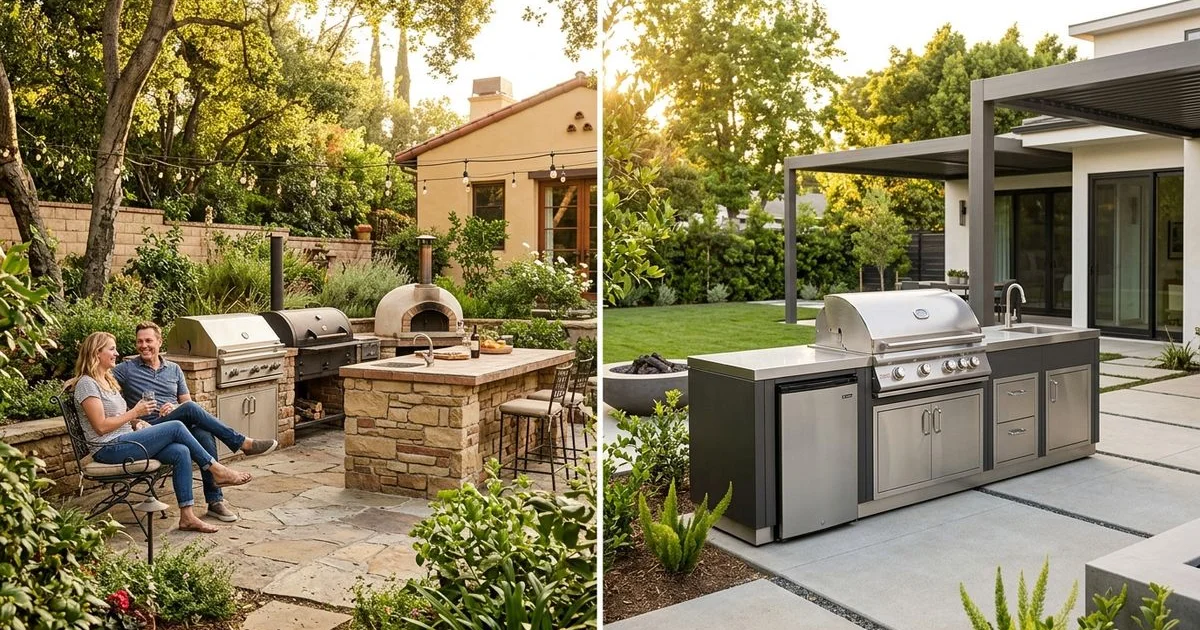
We constantly talk with homeowners facing the exact same choice for their backyard upgrade.
The debate between a built in bbq vs modular outdoor kitchen usually comes down to budget, permanence, and aesthetic goals. Both approaches are completely legitimate ways to transform your patio.
Our team typically looks at the property’s long-term master plan before making a recommendation. Let’s explore the data behind both options and outline exactly how to choose the right path for your specific landscape.
Quick comparison
When you compare a custom vs prefab outdoor kitchen, the most striking differences are the timeline and the price tag. Our custom masonry projects routinely run twice the cost of modular kits but offer limitless design freedom.
A quick look at the numbers helps clarify the baseline expectations for each route. National averages in 2026 place custom builds at $1,200 to $2,000 per linear foot. We use this data alongside your specific site conditions to calculate an accurate estimate.
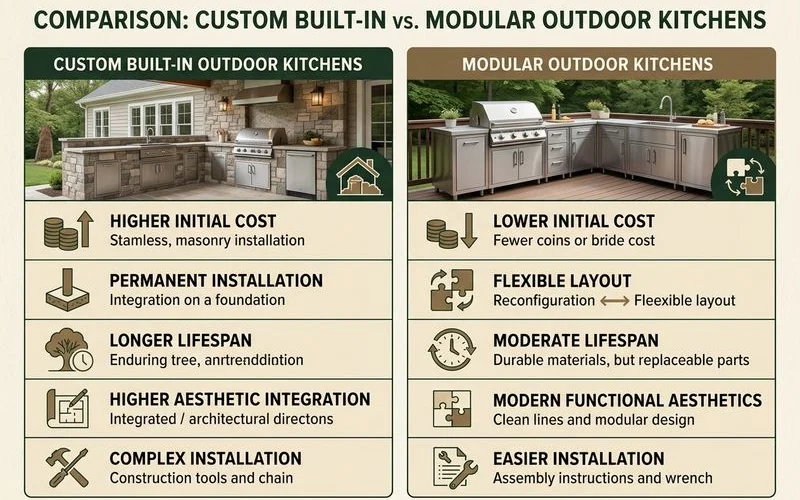
| Dimension | Custom built-in | Modular prefab |
|---|---|---|
| Install cost (typical L-shape) | $40,000 to $80,000 | $20,000 to $50,000 |
| Lifespan | 25 to 40+ years | 15 to 25 years |
| Flexibility (move/modify later) | Permanent | Can be relocated |
| Aesthetic | Site-specific, custom finish | Catalogue look |
| Integration with patio | Fully integrated | Sits on top |
| Material range | Any masonry, any countertop | Limited to manufacturer offerings |
| Install timeline | 4 to 6 weeks | 2 to 3 weeks |
| Custom dimensions | Yes | Within manufacturer modules |
Custom built-in: pros and cons
The custom built-in approach creates a permanent architectural feature that perfectly matches your home. This option requires deep footings and extensive site prep before any blocks are stacked. Our masonry crews spend weeks carefully crafting these structures to ensure they last for decades.
Pros
- Aesthetic integration: This feature is the biggest advantage of a custom build. The masonry shell can be stuccoed, stone-veneered, or tiled to match the architecture flawlessly.
- Our precise sizing: The team sizes these structures exactly to the patio footprint, your cooking style, and specific appliance choices.
- Premium materials: Material options are virtually unlimited. You can select any countertop, any masonry style, and any cladding.
- Our permanent integration: Clients appreciate the value of having water and gas plumbed directly into the home’s systems without awkward transitions.
- Proven longevity: Durability is guaranteed since properly built masonry shells last decades. Recent 2026 real estate data shows that a well-designed custom kitchen yields an average return on investment of 55% to 80% in regions like Southern California.
- Our market observations: The team consistently sees properties in our area command top dollar when they feature these permanent outdoor living upgrades.
Cons
- Higher installation costs: This is the primary drawback of real masonry and custom fabrication. The longer installation timeline typically stretches to 4 to 6 weeks versus 2 to 3 weeks for modular setups.
- Our intensive process: The installation phase involves heavy equipment that can sometimes disrupt existing landscapes.
- Permanent placement: These kitchens are permanent structures that can’t be moved or significantly modified later. Custom design work adds soft costs for architectural drawings, material selection, and extensive decision-making.
- Our drought warning: The team always warns drought-conscious homeowners that trenching for new footings and utilities can disturb the root zones of established, water-wise trees like California Sycamores.
Modular prefab: pros and cons
Modern modular outdoor kitchens from brands like Brown Jordan Outdoor Kitchens, Hestan, and Lynx have improved dramatically in recent years. These premium modular units use stainless steel frames with high-performance cladding panels made of cement board, porcelain, or stone veneer.
Our designers often specify these kits because they read very close to custom masonry from a distance.
Pros
- Lower installation costs: These projects generally run 20% to 40% less than a custom built-in project. A faster installation timeline gets you cooking in 2 to 3 weeks instead of 4 to 6 weeks.
- Our favorite feature: The team loves that modular units are movable and can be relocated if you redesign the yard or move to a different property.
- Reduced site prep: These systems avoid the $500 to $3,000 demolition and site preparation fees common with heavy masonry. The modular bbq island sits directly on top of existing hardscape.
- Our eco-friendly advantage: Eco-focused clients appreciate this because it protects the delicate root systems of surrounding drought-tolerant plants like Ceanothus and Blue Fescue.
- Manufacturer warranties: These guarantees provide serious peace of mind. You often get 5 to 10 years of protection on the frame and cladding.
- Our predictable process: The ordering phase is highly predictable since what you request from the catalogue is exactly what arrives on site.
Cons
- Less flexibility: This constraint is the main trade-off since you must fit your design to the manufacturer’s exact dimensions. The final product always reads slightly like a kit, especially when viewed up close.
- Our finish limitations: Buyers sometimes feel constrained by the limited options in a manufacturer’s catalogue.
- A shorter lifespan: Wear and tear happens faster because metal frames and panel cladding age quicker than properly built concrete block shells. While top-tier stainless steel frames hold up well, lower-grade options will eventually succumb to moisture and rust.
- Our climate check: The crew always verifies the material grade to prevent premature corrosion in coastal or damp microclimates.
When custom built-in wins
- A custom masonry kitchen is the clear winner for a permanent residence with a multi-decade ownership horizon.
- This path makes sense for a premium home where structural integration matters just as much as cooking function.
- We highly recommend this approach if you desire a custom aesthetic that a standard catalogue simply cannot deliver.
- Patios already designed for built-in proportions are perfect candidates for this route.
- You need an adequate budget for the premium materials and specialized masonry labor.
- Our team usually specifies custom builds when homeowners want to visually integrate the kitchen with extensive, permanent drought-tolerant landscaping features.
When modular wins
- A modular setup wins easily if you have a shorter ownership horizon and plan to sell within the next 5 to 10 years.
- It is also the smart choice if you have a tighter budget specifically allocated for the outdoor kitchen.
- We suggest prefab units for renovation projects where committing to permanent masonry is not desired.
- Renters or properties where movability matters greatly benefit from these systems.
- A faster install timeline is a massive advantage when you want to use the space before the summer ends.
- Our landscape architects utilize modular frames to keep construction vehicles away from established, low-water gardens.
What we typically build
The vast majority of Ridgeline outdoor kitchen projects are custom built-in installations.
Most clients we work with are planning long-horizon residences in Pasadena, Beverly Hills, and San Marino. We find that permanence and integration are the baseline assumptions for properties in these neighborhoods.
Our construction crew integrates these prefab units into the patio and pergola design as cleanly as possible.
For more details on the planning phase, see our outdoor kitchen design ideas. Reach out to us today to schedule a site consultation and discover which kitchen style fits your backyard best.
Frequently Asked Questions
Is a modular outdoor kitchen cheaper?
Can a modular kitchen be moved later?
Which lasts longer?
Have questions about a project of your own?
A free on-site consultation, a phased budget tier, and a master plan that fits your property and your goals.